

$50.00 U.S. (trade discount)
No e-book has been authorized.
Hardcover with jacket
128 pages with 78 duotone photographs by the author
9.0″ x 11.0″ upright/portrait
ISBN: 978–1–938086–00–7
Published in January 2013
Distributed by Casemate/IPM
www.casemateipm.com
No e-book has been authorized.
Book Events:
June 26, 2013 from 6:30-8pm
Skyscraper Museum, New York City
Lecture and book signing
Museums that have On Wall Street in their libraries:
Amon Carter Museum of Art
Fogg Museum, Harvard University
Metropolitan Museum of Art
J. Paul Getty Museum
Philadelphia Museum of Art Princeton
University Gallery of Art
Smithsonian Museum of American Art
Museum of Fine Arts, Houston
Center for Creative Photography
George Eastman Museum
National Gallery of Art
Yale University Gallery of Art
Rhode Island School of Design
by David Anderson
Introduction by Paul Goldberger
Nominated for a 2013 Independent Publisher Book Award, and the 2013 New York City Book Award.
All 78 photos from On Wall Street are now in the permanent collection of the New York Historical Society. (2020)
“I am not sure there is any other pair of monosyllabic words in the English language that evokes as powerful a sense of place as Wall Street, except, of course, New York itself.” So writes famed architectural critic Paul Goldberger in his introduction to one of the most important photographic books on New York City to appear since 9/11: David Anderson’s On Wall Street.
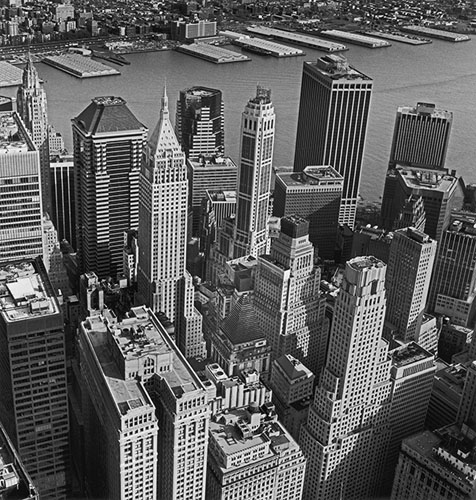
During the 1970s, a lot of glass-and-steel, boxlike buildings were going up in New York City. David Anderson realized that the architecturally elaborate and stylistic buildings of the late nineteenth century through the 1930s that defined Wall Street would never be made again. He thus embarked on a remarkable twenty-year project (from 1980 to 2000) to document Wall Street’s classic architecture before further changes were made in the area, including the demolition and destructive renovation of too many historic structures.
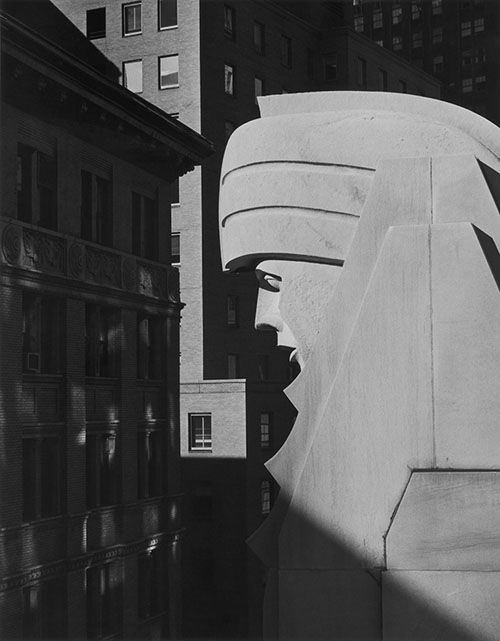
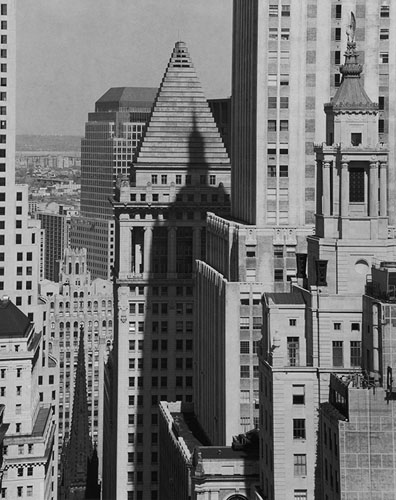
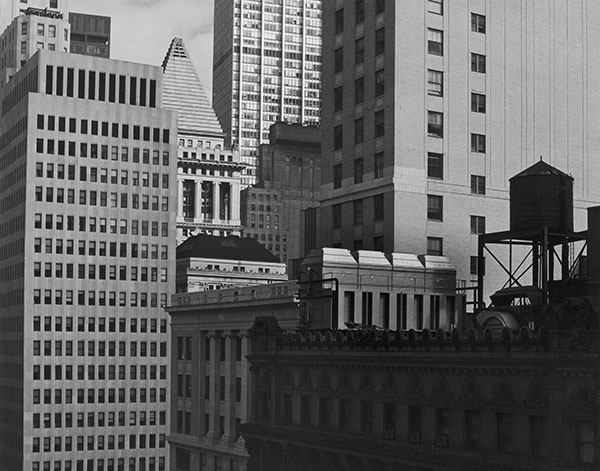
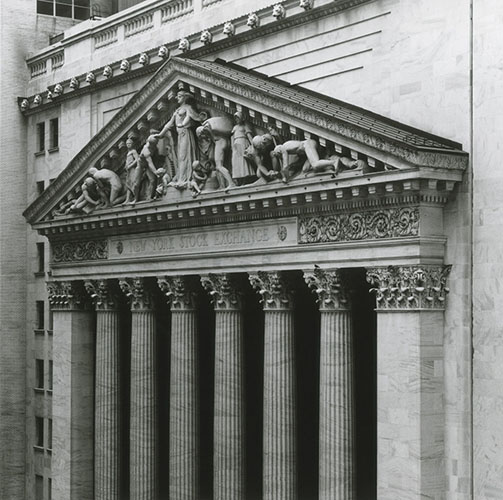
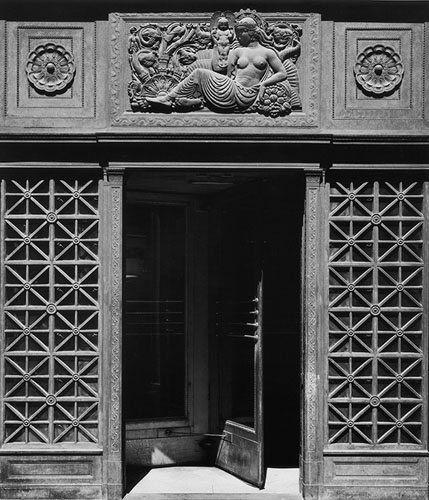
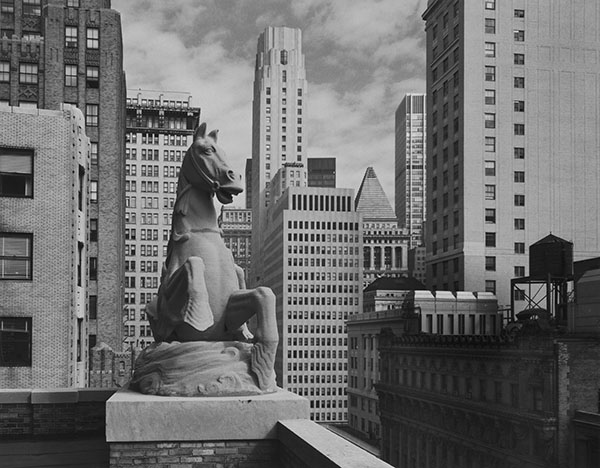
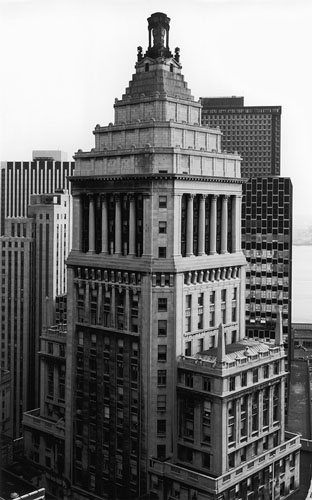
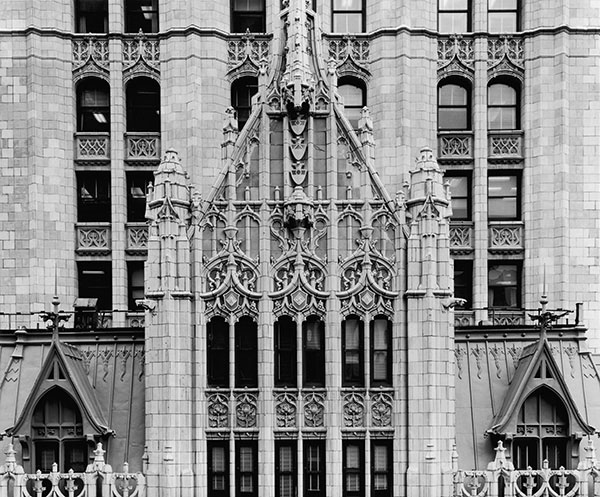
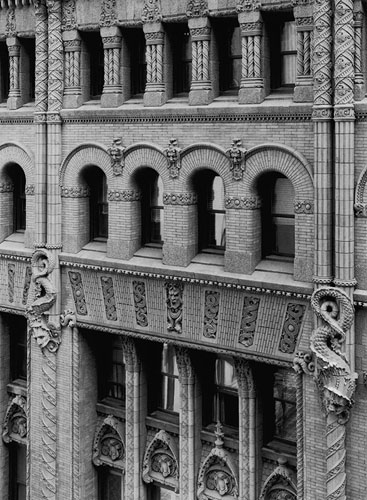
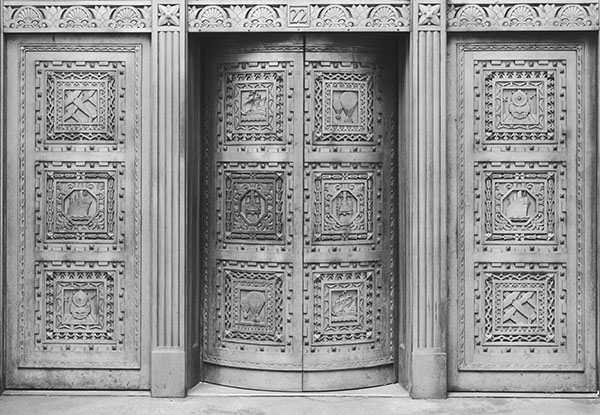
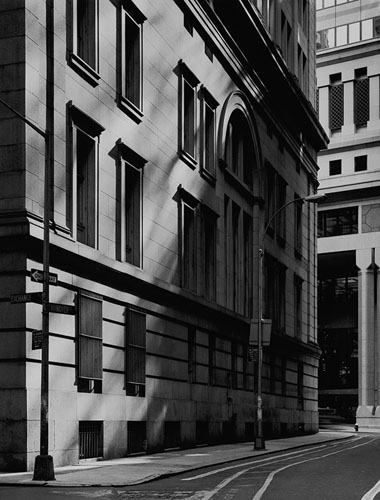
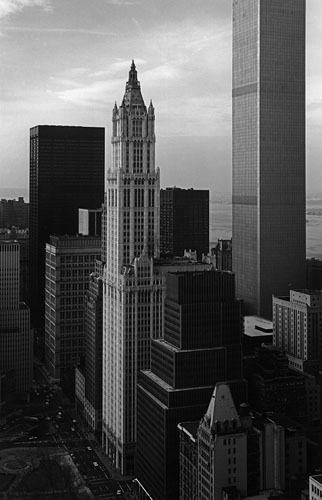
Anderson’s approach to photographing Wall Street is unique. He avoids people, vehicular traffic, and storefronts, and rarely does he present a view of an entire building. Instead, he focuses on the details or a certain profile in order to reveal a building’s architectural form and energy and its larger sense of place within the city’s urban fabric.
Anderson’s photographs of Wall Street will forever be part of the visual record of a by-gone era that emphasized artistic craftsmanship rarely achieved in modern buildings. Like the historic skyscrapers and civic buildings that Anderson depicts, his photographs are equally solid, self-assured, and beautiful. Collectively, they capture the architectural genius, elevated spirit, and harmonious scale of this special place in the financial capital of the world.
About
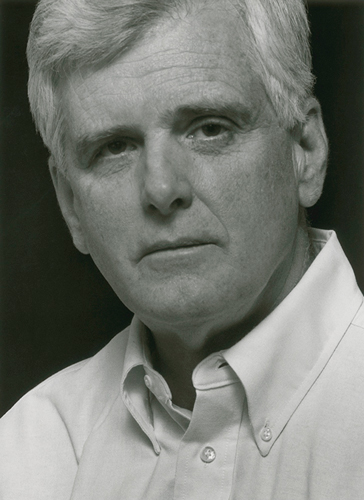
About the Author
David Anderson was born in Lincoln, Nebraska, in 1943 and was raised there. At age seventeen, he showed his photographic work to Alfred Einsenstaedt at Life Magazine, who encouraged him to begin his career at the New York Daily News. After serving in the U.S. Army as a cameraman, including duty in Vietnam, from 1969 to 1983 he was a cinematographer based in New York City who specialized in commercials and documentaries. He also photographed two independent films directed by artist Nancy Graves, including Isy Boukir (1971), which was acquired for the collection of films at the Museum of Modern Art. Since 1983 he has worked as an architectural photographer and is represented by the Yancey Richardson Gallery, of New York City. His photographs are in numerous public and corporate collections, including American Airlines, Amon Carter Museum of American Art, AT&T, the Brooklyn Museum, the Canadian Centre for Architecture in Montréal, Citicorp, Deutsche Bank, Equitable Life Assurance Society, the Library of Congress, the Amon Carter Museum of American Art, the Fralin Museum of Art at the University of Virginia, the Museum of the City of New York, and the Sheldon Memorial Art Gallery at the University of Nebraska in Lincoln, the Vassar College art center among others. After living in New York City for fifty years, Mr. Anderson moved in 2010 to the Hudson River valley of New York.
www.davidvanderson.com
About the Essayists
Paul Goldberger was born in 1950 in Passaic, New Jersey, and was raised there. He began his career at The New York Times, where, in 1984, he won the Pulitzer Prize for his architectural criticism, and then served as the architecture critic at The New Yorker from 1997 to 2011, where he wrote the magazine’s celebrated “Sky Line” column. He has held the Joseph Urban Chair in Design at The New School since 2006 and from 2004 to 2006 was Dean of the Parsons School of Design, a division of The New School. In addition to the Pulitzer Prize, he has also received the Medal of the American Institute of Architects (1981), the President’s Medal of the Municipal Art Society of New York (1984), the Medal of Honor of the Landmarks Preservation Foundation of New York (1996), and the Preservation Achievement Award of the New York City Landmarks Preservation Commission (1996). Since 9/11 he has been intimately involved in the planning and rebuilding of Ground Zero. His books include Christo and Jean-Claude (Taschen, 2010), Why Architecture Matters (Yale, 2009), Up from Zero: Politics, Architecture, and the Rebuilding of New York (Random House, 2004), On the Rise: Architecture and Design in a Post-Modern Age (Times Books, 1983), The Skyscraper (Knopf, 1982), and The City Observed―New York: A Guide to the Architecture of Manhattan (Random House, 1979), among others.
Slide Show
Praise
Photo-Op: Going Up
The buildings of New York’s financial district are a record of centuries of spiraling growth. A photographic review of David Anderson’s “On Wall Street.”
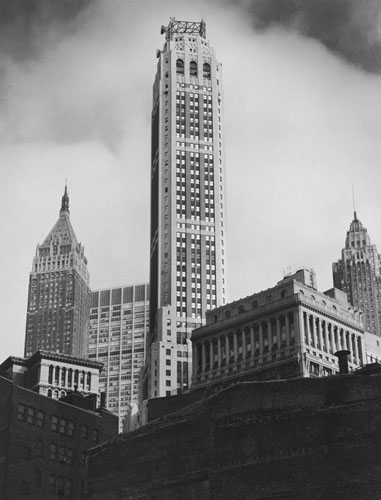
“The sturdiest structure in any small town is the bank—or the building it used to inhabit. Those hunks of columned limestone still anchor downtowns across the country, often converted into grocery stores or shopping arcades. And even on Wall Street, luxury apartments have colonized high-rise wonders like R. H. Robertson’s 1899 building at 15 Park Row (looming in the foreground left)—once the tallest office building in the world. Drawn from David Anderson’s On Wall Street: Architectural Photographs of Lower Manhattan, 1980–2000 (George F. Thompson, 128 pages, $50), this photograph from 1981 captures the upward and outward spiral of the financial industry over the centuries, from the steeple of St. Paul’s (1796), to the Park Row building to the 1924 AT&T building (center), to the World Trade Center’s south tower, stretching out of the frame a few blocks away. Shot in silvery black and white, the pictures emphasize the cool solidity of the often fortress-like subjects, as in the defensive turrets and machicolations of the Federal Reserve Bank. (It’s only fitting: Wall Street got its name by marking the fortified edge of the young city.) But Mr. Anderson also has an eye for delicate details—he picks out the swirling grain in the facade of the Stock Exchange—and for whimsical decorations. On a high balcony at 67 Wall Street (now, too, converted into condos), a stone eagle surveys the street, secured by a chain that seems like a leash. These images—free of cars, signs and people—freeze the city in time. But everywhere you look are traces of bygone eras: the now-vanished Trade Center; a small ‘First Class’ sign on a former steamship terminal; and, carved in stone above a door on William Street, ‘Lehman Brothers.'”
—The Editors, Wall Street Journal
“David Anderson’s poignant photographs capture the coldness, power, and impregnability of the mythical Wall Street. Devoid of the flux of street movement and crowds, the monuments speak. Creatures keep watch, frozen in stone, while surprising traces of decay and delicate detail suggest the contingency, even frailty, of human existence. Paul Goldberger’s masterful introduction guides us as well in seeing and appreciating this historic citadel of American finance.”
―Gail Fenske, author of The Skyscraper and the City: The Woolworth Building and the Making of Modern New York and Professor of Architecture at Roger Williams University
“From 1980 to 2000, photographer David Anderson documented Wall Street’s architecture as few others have. Through an extensive range of black-and-white images whose focus is equally on the historic character and iconic nature of the buildings, a real sense of this famous place emerges. I compare the look and feel of Anderson’s photographs to some of the great urban photographers of all time: Berenice Abbott, Eugene Atget, Paul Strand, and, more recently, Thomas Struth and Bob Thall. On Wall Street will be an immediate classic that not only appeals to the aesthetic of architects, historians, and photographers, but also functions at street level for those who love cities everywhere and, especially, New York.”
―William Wylie, author of Cararra and Professor of Art at the University of Virginia
“On Wall Street: Architectural Photographs of Lower Manhattan, 1980–2000 by David Anderson, with an introduction by Paul Goldberger, is a highly acclaimed black-and-white photography book which documents the historic and architecturally beautiful buildings of the Wall Street district that were designed and built by craftsmen of a bygone era of the Victorian Era. The images were made over a 20-year period, and the photographer ended his project a year before the bombing of the Twin Towers. The book is important not only for the expert photographs and excellent commentary about the photos, but also because 9/11 showed us that, no matter how permanent structures appear, they will not be here forever. Photographers, historians, and architecture enthusiasts will want this book for their collection.”
—Bonnie Neely, owner of Real Travel Adventures and book reviewer for Amazon
“An architectural shift left Manhattan with an unusual blend of buildings. On Wall Street: Architectural Photographs of Lower Manhattan, 1980-2000 is a collection of black-and-white photography from David Anderson, snapping photos on the aftermath of the new construction past the 1970s, offering a snapshot of the twilight of the twentieth century with soulful black-and-white photography, capturing the details of these buildings. On Wall Street is a must for historical and architectural photography collections; highly recommended.”
—Internet Bookwatch, Midwest Book Review
“Anderson had been working as a cinematographer for at least fifteen years before becoming an architectural photographer in the early 1980s. He explains in his preface that he decided to document Wall Street’s buildings, knowing that the particular aesthetic and harmony of their design was not being replicated in newer buildings and wishing to capture their distinctive geometry and details. The project took him twenty years. This volume presents his black-and-white images full page, with an introductory essay by architecture critic Paul Goldberger. The book measures 9.0″ x 11.0”.
—Eithne O’Leyne, Editor, ProtoView, Ringgold, Inc.