
$45.00 U.S. (trade discount)
No e-book has been authorized.
Hardcover
168 pages with 151 color photographs by the author
12.0″ x 9.0″ landscape/horizontal
ISBN 978–1–938086–69–4
Published in February 2020
Distributed by Casemate/IPM
www.casemateipm.com
No e-book has been authorized. Published in association with the American Land Publishing Project, Middlebury College, and Furthermore, a program of the J. M. Kaplan Fund.
Events and Exhibitions
April 22, 2024
Nature, Photography, and The Dharma: A Reflection from John Huddleston
part of TRICYCLE’S BUDDHISM & ECOLOGY SUMMIT: TOUCHING THE EARTH An Earth Day Event Series
Read an interview with Huddleston in Tricycle (2022)
View Huddleston’s work and read an interview on the Middlebury Magazine
Read an interview with Huddleston in Vermont’s Seven Days
by John Huddleston
with an essay by Bill McKibben
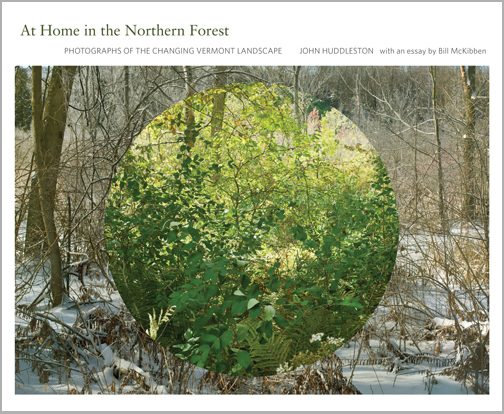
The Northern Forest of North America—stretching from New England and eastern Canada into the Upper Midwest—is one of the world’s largest contiguous forests. Complex and beautiful, it supports a wide variety of life, and its woodlands offer an interconnected vastness that gives American and Canadian lives perspective and balance. This book is timely, for the Northern Forest is at the heart of important environmental and economic issues that have become critical, especially as big logging companies sell off large portions of their land.
The very existence of this forest is extraordinary. For instance, in 1870 the forest covered just twenty percent of Vermont, but today nearly eighty percent is woodland. This remarkable turnaround has taken place on what is overwhelmingly private land. As environmentalist Bill McKibben observes, “This unintentional and mostly unnoticed renewal of the rural and mountainous east represents the great environmental story of the United States and, in some ways, the whole world.” But forest acreage has begun to decrease in every state in New England, as trees are removed for commercial development.
Renowned photographer John Huddleston brings a contemporary vision to show the unique and transitory character of the amazing Northern Forest. His photographs were made with precise attention to ordinary beauty and circumstance as he hiked in the Vermont woods he has known for thirty years. Through his photographs we gain a deep appreciation and understanding of the Northern Forest and how proper forest management enhances both commercial and ecological interests. Under Huddleston’s care, natural change is embodied in a new type of photographic composite created from exposures made of similar scenes in different seasons. This difficult, labor-intensive process elicits direct comprehension of cyclic time. Coupled with his straight photographs, the book reveals the dynamic forms and processes of the Northern Forest. And an array of text references explores the biology, economics, history, philosophy, and vulnerability of this vast regional landscape.
About
About the Author
John Huddleston is the Fletcher Professor of Studio Art Emeritus at Middlebury College. He has had numerous one-person exhibitions, including those at the Contemporary Arts Center in New Orleans, DeCordova Museum in Lincoln, Massachusetts, Massachusetts Institute of Technology Museum, University of California, Riverside, Art Gallery, Wave Hill in New York City, and Wichita Art Museum, among others. Huddleston’s other books are Killing Ground: Photographs of the Civil War and the Changing American Landscape (2002), for which he won an Andrea Frank Foundation Grant, was interviewed on National Public Radio, and received a glowing review in The New York Times Book Review, and Healing Ground: Walking the Small Farms of Vermont (2012), which draws on the ordinary and emphasizes a commitment to place. Huddleston has received grants from the Ada Howe Kent Foundation, Elizabeth Firestone Graham Foundation, National Endowment for the Arts, Vermont Arts Council, and Vermont Community Foundation, and his video work has received awards from Tokyo to London.
About the Contributor
Bill McKibben is the Schumann Distinguished Scholar in Environmental Studies at Middlebury College, a Fellow of the American Academy of Arts and Sciences, and a founder of 350.org, the first planet-wide, grassroots climate change movement. A former staff writer for The New Yorker, McKibben is the author of more than a dozen books, including Falter: Has the Human Game Begun to Play Out (2019), Eaarth: Making a Life on a Tough New Planet (2010), Deep Economy: The Wealth of Communities and the Durable Future (2007), Wandering Home: A Long Walk Across America’s Most Hopeful Landscape: Vermont Champlain Valley and New York Adirondacks (2005), and The End of Nature (1989). McKibben was the 2013 winner of the Gandhi Prize and Thomas Merton Prize, in 2014 was awarded the Right Livelihood Prize, sometimes called the “alternative Nobel Prize,” and was named by Foreign Policy in its inaugural list of the world’s 100 most important global thinkers and by The Boston Globe as “probably America’s most important environmentalist.”
Slide Show


Praise
“A wonderful book! John Huddleston’s stunning photographs infuse landscape with piercing meditative depths—whether in the revelatory Time Composites series, with its dramatic effects, or in the seemingly more conventional images, with their subtle insights and surprises, clarities and beauties. This work can transform the way you see landscape or anything else.”
—David Hinton, author of Hunger Mountain and Existence: A Story
“Throughout his beautiful, hardcover, glossy book, Huddleston softly captures our attentions with his photographs, welcoming us to “look a little more deeply at the conceptions of form, change, philosophy and psychology” in the woods.”
—Elsie Lynn Parini, Addison County Independent (read full interview here)
My Place
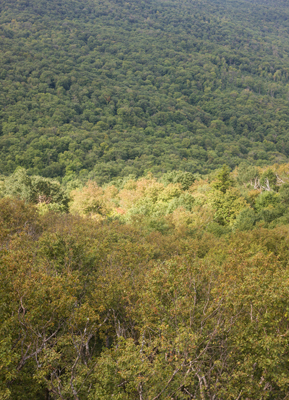
Vermont’s woods are my home. I walk with the camera every day along the logging roads and deer runs in this second-growth forest. Our core sense of beauty arises from our deep connection to this world. We humans are of these forests, and our urbanity rests upon them. Trees produce oxygen, paper, building materials, and fuel. They retain rainfall, reducing floods and droughts. They provide clean watersheds, prevent erosion, moderate the climate, recycle nutrients, store carbon, and are home to insects and animals. But this forested landscape is provisional, for it is a managed, working timberland.
Although the so-called “natural world” is no more real or true than is the human-made environment, it may give us more space to consider our own human nature. The human world is so intentional and manipulated that we easily become reactive and discursive; being in nature some distance from society may allow us to see and contemplate with more clarity. The forest, in particular, offers an interconnected complexity and vastness that give us perspective and balance. Our psyche needs the forest: in the immediate sense of connecting with the sights and sounds and smells of an unfolding walk and in the abstract ways we imagine into the deeply mythical space of the forest. The former sensations can be paradoxically relaxing and exciting, resulting in a calm but precise hunter’s awareness that I share as an artist. The latter archetypes may be spiritually ascendant or physically terrifying, but all reveal ancient foundations of human experience. Trees, even on a city street, give a proportion to our human life. Like us, they are suspended vertically between Heaven and Earth, and they go through remarkable changes over the spans of their lives. The complexity of a forest encourages a broader realization of process: of ourselves in the larger process of life, and of the direct quality of our experience in the present. The forest is my kind of place.
Copyright © 2020 John Huddleston.