
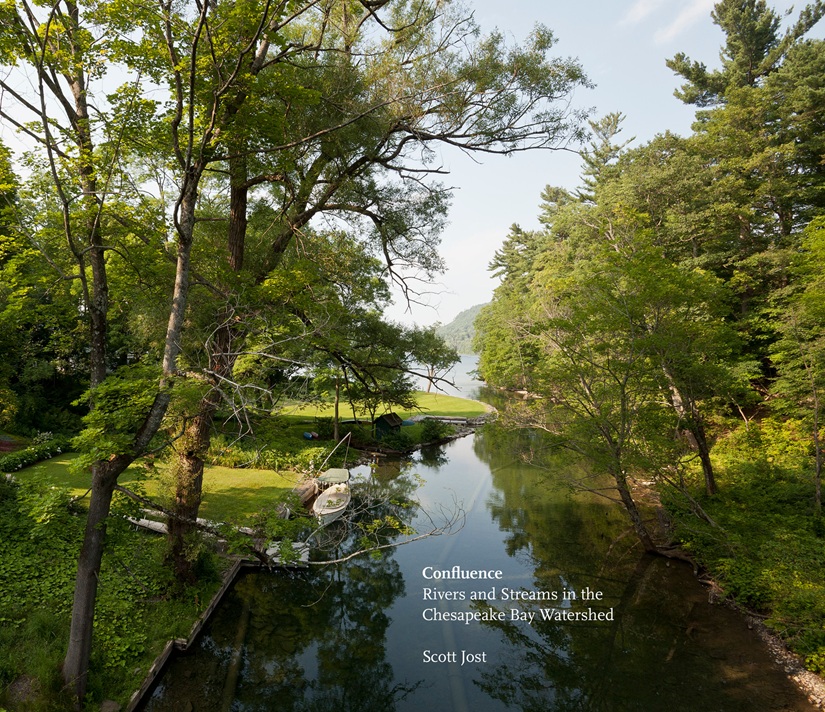
$39.95 U.S. (trade discount)
E-book TBD.
Hardcover/PLC with jacket
192 pages with 72 panoramic plates (comprised of 315 color photos) + 2 diptychs (4-color) + 1 solo (color) + and 3 black-and-white images by the author and 1 color map
11.0″ x 9.5″ (horizontal/landscape)
ISBN 978–1–960521–13–2
Forthcoming in December 2026
Distributed by the The University of Virginia Press
www.upress.virginia.edu
Published in association with the Center for the Study of Place.
Events and Exhibitions
by Scott Jost
with a foreword by William C. Baker, introduction by Seth Feman, and commentaries by Donald F. Boesch, Grace S. Brush, Mark Frondolf, George Hawkins, Ralph Northam, Jodi Rose, Amy Wolfe, and Tommy Zinn
The first book to convey the richness, diversity, beauty, and complexity of the Chesapeake Bay watershed through amazing photos and informative text!
Chesapeake Bay is the largest estuary in the United States and the third-largest in the world. Its watershed extends some 64,000 square miles into six states—Virginia, West Virginia, Maryland, Delaware, Pennsylvania, and New York—and the District of Columbia and is home to more than 18 million people. The Bay’s watershed is also home to one-third of the Atlantic migratory bird population, some 2,700 plant species, and more than 500 finfish and shellfish species. Chesapeake Bay and its watershed are quite simply a national and regional natural treasure. Yet it is threatened.
Scott Jost has traversed nearly every corner of the Bay and its watershed since 2008, focusing on the notable confluences of rivers, streams, and creeks that comprise the watershed. Using multi-frame panoramas, Jost presents an incredible array of scenes, all of which capture the “confluence” and “interface” between the natural and cultural landscapes that define the Bay and our place in it. No artist has rendered a region so thoroughly, so artfully.
Confluence is more than a book of art. It features ten insightful essays and ten additional commentaries by some of the Bay’s most notable scientists, curators, scholars, writers, activists, riverkeepers, and political and spiritual leaders, including a foreword by William C. Baker, President of the Chesapeake Bay Foundation from 1981 to 2021, an introduction by Seth Feman, Director and CEO of the Frist Art Museum in Nashville and former Curator of Photography and Deputy Director of the Chrysler Museum of Art in Norfolk, and Dr. Ralph Northam, Governor of Virginia from 2018 to 2022.
The integration of Jost’s timeless photographs and the accompanying text simulate a huge stained-glass image of Chesapeake Bay and its 50 major rivers and more than 100,000 tributaries. There has never been a book like Confluence, which was created to enlighten and inform the nation and the world about this special place whose health is of vital concern to the 18 million people and countless species who call it home.
About
About the Author
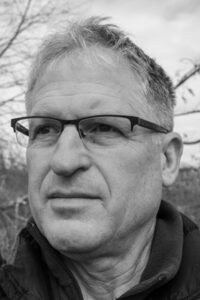
Scott Jost is Professor of Art and Art Department Chair at Bridgewater College where he teaches photography, videography, and advanced studio. In addition to numerous faculty research grants, Jost received the Faculty Scholarship Award from Bridgewater College in 2016 and the Virginia Foundation for Independent Colleges Maurice L. Mednick Memorial Fellowship in 2013. Jost’s photographs have been exhibited widely in the Mid-Atlantic region and nationally and are in the permanent collections of the Chrysler Museum of Art in Norfolk, Virginia, Spencer Museum of Art at the University of Kansas, and Center for the Study of Place. Jost was the contributing photographer for the acclaimed book, The Great Valley Road of Virginia: Shenandoah Landscapes from Prehistory to the Present (University of Virginia Press, in association with the Center for American Places, 2010), and he is the author of Shenandoah Valley Apples (Columbia College Chicago Press, 2013) and Blacks Run: An American Stream (Center for American Places, 1999).
About the Contributors
William C. Baker (who wrote the foreword) was President of the Chesapeake Bay Foundation from 1981 to 2021.
Donald F. Boesch is Professor Emeritus and President Emeritus of the University of Maryland Center for Environmental Science who has spent more than 40 years of his career learning about, conducting and leading research on, and providing guidance to the stewardship of Chesapeake Bay.
Grace S. Brush is Professor Emerita of Environmental Health and Engineering at the Johns Hopkins University.
Seth Feman (who wrote the introduction) is Director and CEO of the Frist Art Museum in Nashville, Tennessee, who, from 2012 to 2012, was Deputy Director for Art and Interpretation and Curator of Photography at the Chrysler Museum of Art in Norfolk, Virginia.
Mark Frondorf is an official Shenandoah Riverkeeper with the Potomac Riverkeeper Network
George Hawkins is CEO and General Manager of DC Water, the District of Columbia’s water and sewer authority.
Ralph Northam, M.D., was Lieutenant Governor of Virginia from 2014 to 2018 and Governor of Virginia from 2018 to 2022.
Jodi Rose has been Executive Director of Interfaith Partners for the Chesapeake since 2013. Under her leadership, the organization has grown to a network of more than 350 congregations: a confluence of faiths, ideas, and acts of restoration.
Amy Wolfe is Director of Trout Unlimited’s Pennsylvania Cold-Water Habitat Restoration Program.
Tommy Zinn is President of the Calvert County Waterman’s Association and a commercial crabber on the lower Patuxent River and Chesapeake Bay.
Slide Show
In Confluence: Rivers and Streams in the Chesapeake Bay Watershed, Scott Jost explored every county of the 64,000-square-mile watershed, the world’s third largest, taking pictures of the confluences of its tens of thousands of streams and tributaries and fifty major rivers that flow from Cooperstown, New York, some 524 miles to Norfolk, Virginia and to the interior Shenandoah Valley, and including the additional states of West Virginia, Pennsylvania, Maryland, Delaware, and the District of Columbia in six geologic provinces. In his book, Jost renders the confluences through three, four, five, and six photographic panels that convey both reality and a sense of place that often reflects an interaction between nature and culture. Here, in this gallery, appear twenty-five of his three-panel photographs.


Praise
“Scott Jost’s truly amazing photographs show us the magical network of rivers, streams, and creeks—confluences—that comprise the Chesapeake Bay watershed. Do we need any more motivation than his magnificent landscape art to scream from every rooftop: Save the Bay!”
—William C. Baker, past President of the Chesapeake Bay Foundation, from his foreword
“Photographer Scott Jost’s multi-frame panoramas operate within the tensions described above: between what can be seen and what remains invisible, between the past and its possible futures, and between what is directly observable and what is allusively known or only imaginable. While his photographs help reveal the fragile environmental conditions of Chesapeake Bay’s watershed, the tensions conjured by many of his panoramas distinguish them from the work of other ecocritical photographers. Neither jarring nor argumentative, his panoramas recall the uncomplicated appearance of traditional landscape photography or even the apparent disinterestedness of a scientific survey. Indeed, he makes what seem to be impartial, documentary views of the waterway as it flows from its many headwaters and confluences to the sea. If the panorama was originally designed to offer totality, the elusiveness of time in Jost’s photographs disrupts any sense of completeness or control. Even while the panoramas seem to fully expose the world, what has happened and what will happen remains unsettled and contingent. What will the fate of the Chesapeake Bay watershed and those 18 million people who live within it and whose lives depend on it? The answers may not yet be apparent, but, inasmuch as Jost’s panoramas remind us that vision is limited and limiting, all the clues are there for finding new ways of imagining our relationship with the land and ourselves, for the land reflects who we are and what we value.”
—Seth Feman, from his introduction
My Place
In pre-dawn January darkness I set out on the county highway from Newton, Kansas, where I grew up, toward Kansas City and a flight that will take me back to Virginia where I live. Past Elbing, I almost recognize a slight shift from black below to black inflected by azure above. Miles pass, and blue and black resolve into separate fields. At the stop sign for U.S. 77, an orange edge has established itself, announcing the horizon. Reaching Cassoday, dawn transitions from red orange to deep blue through a transitional sky space that is both orange and blue but neither orange nor blue. I’ve arrived in the Flint Hills, a rolling expanse of native grasses and plants that, at nearly 10,000 square miles, is the largest remnant of an unplowed tallgrass prairie that once extended from Texas into Canada.
On any day, including blinding summer days when car doors flies open and hot wind scoops you out of the car, the Flint Hills are intensely beautiful. Once while driving a narrow gravel road through freshly burned grassland, a single native redbud in full bloom appeared in a blaze of magenta against the charcoal black hillside. Another time, at night, my flight descended through spring thunderstorms over Chase County while approaching the airport in Wichita. For just a moment, winding ribbons of fire on the prairie below appeared through an opening in thunderheads, illuminated all around by blue-white flashes of lightning. Never a fan of flying, I was so overcome by beauty that I forgot to worry.
These encounters with fire, or the reminders of fire, in the Flint Hills are, for me, intensely aesthetic. But they are more than that. They are reminders that, for millennia, the Flint Hills has been the site of reciprocal relationships between land and humans who tended the prairie, nurturing plants, animals, and people in the process. Fire burned away dead plant matter, invasives, and scrub, refreshing native perennials that, in turn, attract grazing animals. Fire, as a renewing and sustaining process, was adopted by Native Americans, then much more recently by cattle ranchers.
I am easily enamored of places of all kinds, and those of the Shenandoah Valley in Virginia, my adopted home, now occupy me the most. The Flint Hills, though, provided my earliest awareness that pristine landscapes are also human landscapes. The small remaining fragments, and the people who continue to steward them, demand our deep respect.
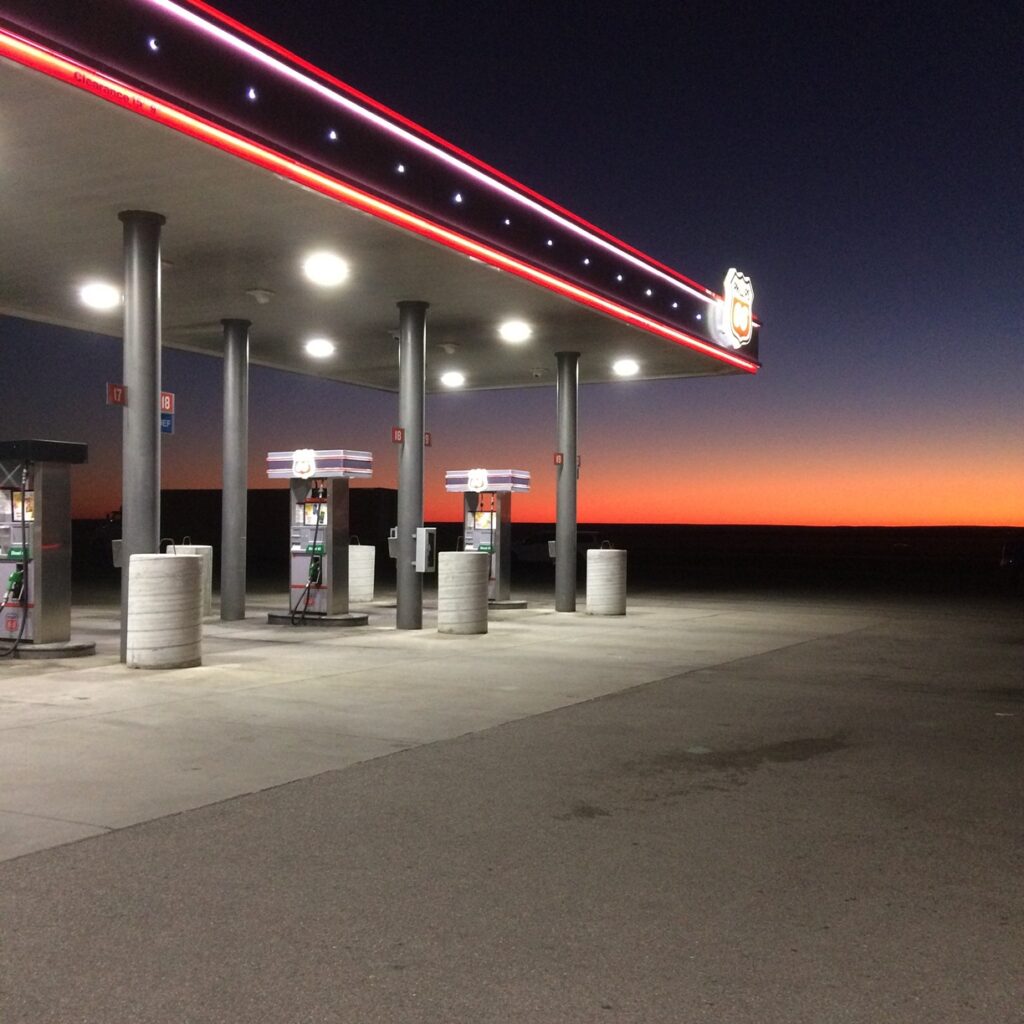
Back in the car after a stop for gas at the Matfield Green Service Area, the light of approaching dawn blazes through billows of dried grass on either side of the Kansas Turnpike, and I feel once again as if I am flying low, approaching home.
Copyright © 2020 Scott Jost. All rights reserved.