
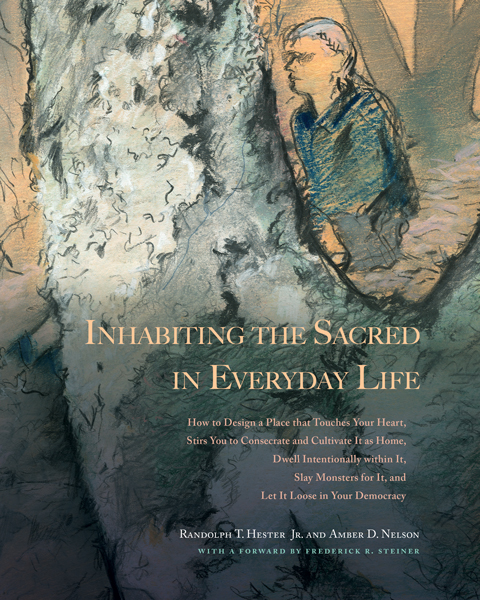
$39.50 U.S. (trade discount)
E-book TBD.
Softcover with gatefold flaps
304 pages with 145 color photographs,
drawings, maps, plans, and diagrams
8.0″ x 10.0″ (upright/portrait)
ISBN: 978–1–938086–65–6
Published in April 2019
Distributed by Casemate/IPM
www.casemateipm.com
Published in association with American Land Project.
by Randolph T. Hester, Jr. and Amber D. Nelson
Foreword by Frederick R. Steiner
A comprehensive and inspirational guide to cultivating and preserving the best qualities of any community, town, or city!
People everywhere hunger, often unconsciously, for places to live and work that are more than efficient machines for economic living. They seek places that enable them to fulfill their humanity, that add meaning to their life, that reintegrate emotion with reason, that enrich one’s self and community.
In their pioneering book, Hester and Nelson explain how to give form in everyday landscapes to our most deeply held values and most ennobling purposes, thus turning profane spaces into sacred places. This transformation, which gives people and communities a sense of nearness and rootedness, may be accomplished in both interior private and exterior civic spaces.
Shaping neighborhood and civic space into sacred place requires a partnership between citizens, government and public officials, planners and designers, and other interested partners. Although large-scale and complex projects usually require the assistance of a professional designer and planner, many projects can be advanced by individuals and community groups. The process and techniques espoused by the authors will also be of use to indigenous peoples, especially in defending the territories essential to the survival of their cultures.
This book was thus written to appeal to all stakeholders who embrace a place. It is presented as an informative and practical guide to envisioning and creating more meaningful and fulfilling habitation that harmonizes local culture and personal experiences. In the first part of their book, Hester and Nelson share personal stories—aha moments—that changed their respective understandings and approaches to community design. In the second part, the authors present six strategies for inhabiting the sacred in any place, no matter the scale. They open each chapter with a theoretical framework and then share successful case studies—from all over the U.S. and globe—accompanied by tried-and-true “how to” techniques. The book concludes with a look toward the future. Beautifully illustrated and highly readable, Inhabiting the Sacred in Everyday Life is sure to be a book of lasting value.
About
About the Author
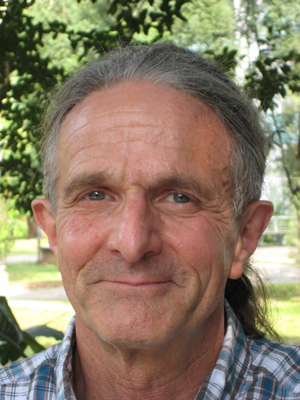
Randolph T. Hester, Jr. is Professor Emeritus of Landscape Architecture at the University of California, Berkeley, the Director of the Center for Ecological Democracy, and a practicing landscape architect in North Carolina. His previous books document fifty years of community-design innovation, including the Neighborhood Guide to the Thoroughfare Plan (Wake Environment Publications 1973), User Needs as Design Criteria (North Carolina State University, 1974), A Citizen’s Guide to Local Government (Goals for Raleigh/Wake, 1975), Neighborhood Space (Dowden, Hutchinson and Ross, 1975), Community Goal Setting (Hutchinson, Ross, 1982), with Frank Smith, Planning Neighborhood Space with People (Van Nostrand Reinhold, 1984), Community Design Primer (Ridge Times Press, 1990), The Meaning of Gardens (The MIT Press, 1990), with Mark Francis, Community Planning Method and Technique (Gendaikikakushitsu Publishers, 1997), A Theory for Building Community (Yungliou Press, 1999), with Sheng Lin Chang, and Design for Ecological Democracy (The MIT Press, 2006).
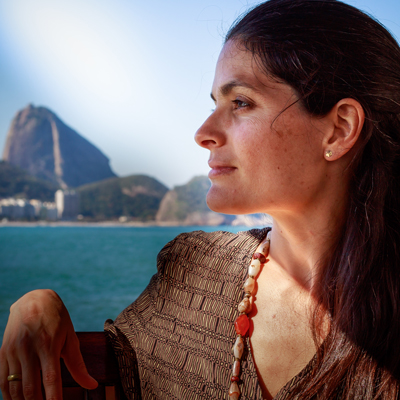
Amber D. Nelson is an independent landscape designer based in Río de Janierio, Brazil, and the South America Destination Manager for a sustainable place-based travel company, Context Travel.
About the Contributor
Frederick R. Steiner is Dean of the School of Design and Paley Professor at the University of Pennsylvania. He is a Fellow of the American Society of Landscape Architects, a Fellow of the American Academy in Rome, and the author and editor of more than a dozen books, including Nature and Cities: The Ecological Imperative in Urban Planning (Lincoln Institute of Land Policy, 2016), with George F. Thompson and Armando Carbonell, named one of the best books of 2016 by the American Society of Landscape Architects, Design for a Vulnerable Planet (Texas, 2011), The Living Landscape (Island Press, 2008), and Human Ecology (Island Press, 2002; 2016).
Slide Show


Praise
“Beautiful drawings and such meaningful words! Reading this book gives me a calming and serene feeling. There is an immediate sensation of being teleported to a spiritual realm. Yet what Hester and Nelson address are very down-to-earth matters of the everyday place. Connectedness of the common and the sacred, coupled with the essential interdependency of justice and space, are the core values that will resonate across time and culture.”
—John K. C. Liu, Chairman of the Building and Planning Research Foundation, National Taiwan University
“In Inhabiting the Sacred in Everyday Life, Hester and Nelson seamlessly interweave profound reflections stemming from decades of hands-on work with remarkably accessible practical advice. The six steps and associated techniques the authors outline move readers through a process of collective learning, making, honoring, and inhabiting sacred places. This beautiful book is a meditation on what it means to belong to a place and to have a place belong to you.”
—Kaitlin M. Murphy, Chair of the Social, Cultural, and Critical Theory Graduate Interdisciplinary Program Graduate Interdisciplinary Program, University of Arizona, and author of Mapping Memory: Visuality, Affect, and Embodied Politics in the Americas
“As an educator, scholar, and landscape architect, I am convinced that Inhabiting the Sacred in Everyday Life should be required reading for all students and practitioners in the environmental design fields. As readers follow Hester and Nelson’s personal and communal journeys, they will learn how the best places should touch the heart, inspire contemplation, and teach the essential nature of interconnectedness.”
—Daniel Nadenicek, Draper Chair in Landscape Architecture, University of Georgia, and author of Cultivating American Civilization: Frederick Billings and Nineteenth-century Landscape Improvement
“Hester and Nelson have produced a personal manifesto to challenge our way of seeing, thinking, and living. This book has value to citizen activists and seasoned designers who need to be reintroduced to the why of design. Poetic and filled with vivid stories and well-placed sketches, maps, and photos, Inhabiting the Sacred in Everyday Life is a must-read for anyone who cares about place.”
—Rodney Swink, Past President of the American Society of Landscape Architects and Senior Associate for Planning and Development at PlaceEconomics
“In our technology-focused culture, the practice of being in and learning with your community is an underappreciated art. Inhabiting the Sacred in Everyday Life is at once a meditation on the power of place and a step-by-step guide to making thoughtful community change in your own neighborhood. Hester and Nelson break down their sophisticated approach to landscape architecture practice into six digestible steps that help designers, planners, and community leaders reconnect with the senses, work across differences, identify shared values, and organize collectively to make meaningful change. The book takes a humble, artful, and practical tone to the important work of community design and weaves design practice back into the sacred rituals of everyday life.”
—Dr. Barbara Brown Wilson, Assistant Professor of Urban and Environmental Planning, University of Virginia, and author of Resilience for All: Striving for Equity through Community-Driven Design
“Combining the wisdom of Randy Hester’s decades-long study of sacred landscapes with a fresh look at the topic by Amber Nelson, this delightful and beautifully illustrated book should speak to every student in every design and planning program. In describing the techniques toward inhabiting the sacred, the authors also provide specifics on how to preserve those special places in our everyday landscapes and everyday lives.”
—Linda Jewell, Professor Emerita of Landscape Architecture and Urban Design, University of California, Berkeley, and Fellow of the Council of Educators in Landscape Architecture
My Place


There are places that make me sing with joy; others can make me weep. These are places of the heart. Some recall childhood magic and adolescent growth; others are cities where I have worked on projects for many years. Almost all are places that I had a hand in making. Few are extraordinary. Most are everyday places.
Of all these, the landscapes of Hesters Store, North Carolina, are most special. They shaped me just as I shaped them. They forged my identity and taught me how to design. In fact, they taught me almost everything I know, most of what I have taught others, and everything that I contributed to Inhabiting the Sacred in Everyday Life. There is the homeplace that my grandson, Atticus, told me loved him.
There is Kurama where he asked why God created such an arrangement of rocks. There is cropland where Daddy expected me to endure the pain of repetitive labor and learn to thrive on it; his watermelon patch where he initiated Marcia to more than a single slice, all heart; the east-facing slope where Mother introduced me to wildflowers; the deer stand my son, Nate, and his wife, Saralynn, gave me where I paint sliver moons reflected in still water; Sofa Rock on Knotty Creek where wood ducks share the secret to life with me and suggest that I sit still if I am pursuing wisdom. I love these places, and they love my family and me in return.
The land at Hester’s store has been farmed by Hesters since before the Revolutionary War. My grandson is the tenth generation. The place provides security and reciprocates caring. North Carolina was the poor man’s paradise, and the place fulfilled the Hesters. By my dad’s generation, the land had been gifted to so many descendants that his parents’ small farm couldn’t sustain our family. We were landless. We day labored in tobacco so Daddy could buy back the land he grew up on. The landscape transferred his value of land stewardship to me. He is dead, but the land continues to convey his values. The cultivated land we cut from the oak-hickory forest embodied the need to attend the most nuanced grading and drainage for soil conservation.
Each field held special meaning. One embodies Shorty Lawson, the black sharecropper with whom I cropped tobacco my entire youth. That field sloping down to Hyco Creek contains his spirit and a brotherhood beyond the color of skin. I learned the colors of skin and humanity from Shorty Lawson.
During the past four years I have created a “museum” as a tribute to Cornell “Shorty” Lawson. It was and is a most special place for me. Lawson was born in Caswell County, North Carolina, on March 5 1938. He was a tenant farmer all of his life. For most of that time he lived in the house on the Tom Bowes Farm that I am making into the museum. He was widely known throughout the community for his honesty, his sense of good and bad, his work ethic, his strength, his endurance, his capacity to make dignified things from scrap, his manly humanity, and the way he raised his children. Race constrained his fortune, but he did not let racism define him. Because I worked with him every day during the most formative period of my life, he taught me more about farming, hard work, race and class, caring and enduring values than anyone else. He dispelled every racial stereotype of our time. He was the single hardest-working man I have ever known. When we pulled tobacco, he worked two rows. I worked one, and he always met me coming back, helping me with my single row. He died in 1974.
After Shorty died, his house fell into disrepair. The oak sill rotted; the south wall collapsed into the overgrown yard. I didn’t want his memory erased, so I started repairing the house with discarded materials I found on the farm. That was how Shorty had once improved the place. I had no expectation to do anything more. But a neighbor stopped by and asked why I was working on that old tenant house, and, without thinking, I responded, “I’m making a museum for Shorty.” That crystallized my subconscious intention.
Shorty’s daughter, Carolyn, and I started meeting to share stories about her father. Family and neighbors offered memories of him. A film maker undertook a documentary. I mapped the family’s sacred places and drew house and site plans to reconstruct lost places. I content analyzed all the stories from which grew a concept: Each room illustrates the daily life of Shorty’s family from about 1950 until his death. But instead of furnishing each space as a history museum, we use outsider art, combined with the text we wrote, to explain Shorty’s remarkable character.
To history he was just another tenant farmer, but his story should not be forgotten. He lived by the seasons, so one room tells of family life in summer (tobacco, illustrated with a painting of worming rows of the cash crop), fall (selling, buying, and repairing, illustrated by an old mule collar Shorty patched), winter (hog killing, shown in a painting by memory artist Bernice Sims), and spring (plowing, planting, and mating, depicted in a tin cutout “Mr. Rooster Tending the Chicks after His Wife Left Him” by outsider artist Buddy Snipes). Other rooms focus on food production, family values and fishing, work and prejudice, snakes, God, and the Devil.
I left most of the rooms painted “Haint Blue” or repainted them that special electric hue to keep ghosts away. Shorty had added two rooms as he had more expendable income, so I painted those rooms gallery white to better display the art depicting tenant farming. The art is primarily done by untrained African-American artists who created folk, visionary, or resistance works during the Jim Crow era up to the present. Many of these artists had been Southern tenant farmers themselves, so their paintings capture the detail and passion of Shorty’s life. Works by Willie Jinks, Mama Johnson, Thorton Dial, Mose Tolliver, Mary T. Smith, and Purvis Young express the essence of chores and emotions the Lawsons experienced. They make you sweat in July’s heat, delight when a big fish hits your hook, and fly back to Africa on the wings of an owl to escape slavery. Eula Parris’s paintings show not only harsh everyday life, but also how the landscape itself felt. Benny Grinstead carved mules at work that are more like mules at work than mules at work. Charlie Lucas created the touching Lawson family portrait as a present for the museum; Joe Minter gifted a magnificent African Queen.
Shorty’s wife, Annie, and their older daughter, Carolyn, cooked on both a wood stove and an electric one. They had electricity but no well. Water had to be fetched from the Big House across the Tom Bowes Road. Shorty’s invention to collect rain water to wash clothes is shown in a Wringer washer, and the bucket to wash hair is depicted in a painting by Black Joe Jackson as both extreme hardship and creative solution. Many of the family’s most cherished places were outside the house. In recent months I have rebuilt the woodshed, smokehouse, outhouse and basketball goal, repaired tobacco barns, laid out garden, clothes line, hog lot, and chicken coop.
Today my cousins, five and eight years old, visited the museum for the first time. They studied Shorty’s portrait as their grandfather described him, but mostly they touched things as if the art was speaking to them not by sight but by more intimate senses. Caroline’s favorite thing was a jet plane by O. L. Samuels illustrating how Shorty transitioned from a one-mule economy to machinery more powerful than his extraordinary strength. Anniston wanted to know why the African Queen was bound by chains and locks. We talked about slavery. She also asked why there were four chairs, two black and two white, one fine and the others worn or worse, in a circle, but the answer was interrupted by her sister’s delight in a sculpted mule with a tail made from bells that Caroline was ringing. They wanted to know how you flushed the toilet in the outhouse and were amazed that one pooped into a hole in the ground. They offered keen observations like “This house is small” and asked penetrating questions about race that the museum will answer in time. I could feel their young compassion for Shorty’s family. They seemed to know that this was a special domain.
This project is a labor of love. It is a special place, yes, even sacred, to me. I hope it will move visitors to joy and tears, spur thoughtfulness about things that matter, impel others to cross boundaries of all sorts, and stimulate creative, even unconventional radical action. This “museum” now has a new life of its own that could not have emerged in this form under any other cultural, environmental, and personal circumstances. I work on it most days. Today I repaired the foundation. No one would hire me to do concrete patch work, but I managed to close holes that were letting cold air chill the house. I finished the job just in time to warm the spirit of Cornell Lawson and his family as the wind chill dropped to twelve degrees. I imagined that he invited me in to sit by the kitchen fire.
Copyright © 2019 Randy Hester. All rights reserved.