
$40.00 U.S. (trade discount)
No e-book has been authorized.
Hardcover with jacket
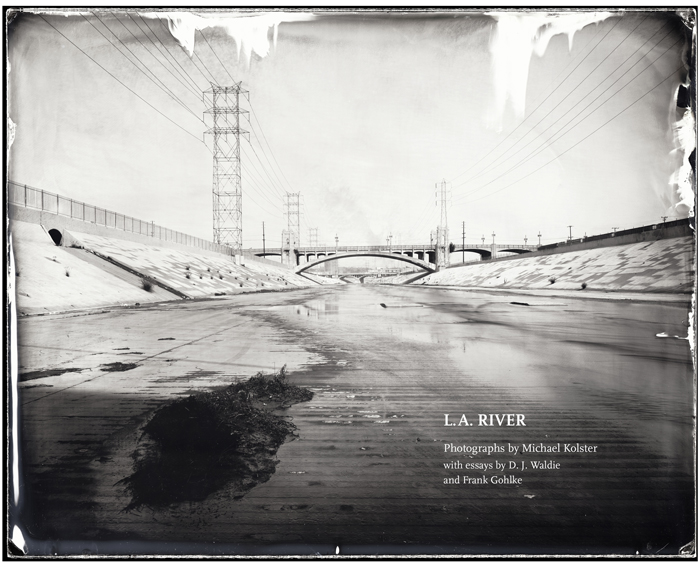
152 pages with 108 ambrotypes (including six foldouts) by the author, three historic photographs, and one map
11.0″ x 9.0″ landscape
ISBN 978–1–938086–64–9
Published in May 2019
Distributed by Casemate/IPM
www.casemateipm.com
No e-book has been authorized.
Published with the American Land Publishing Project.
by Michael Kolster
with essays by Frank Gohlke and D. J. Waldie
A powerful contemporary look at the Los Angeles River using nineteenth-century technology!
Three centuries ago, the Los Angeles River meandered through marshes and forests of willow and sycamore. Trout spawned in its waters, and grizzly bears roamed its shores in search of food. The river and its adjacent woodlands helped support one of the largest concentrations of indigenous peoples in North America, and it also largely determined the location of the first Spanish Pueblo and ultimately the city itself. The Los Angeles River was also the city’s sole source of water for more than a century before flood-control projects made the river a ribbon of concrete.
Michael Kolster, in L.A. River, relies on a nineteenth-century photographic technology to render the Los Angeles River today, from its headwaters in Canoga Park and the suburbs of the San Fernando Valley to its mouth at the Pacific Ocean in Long Beach. Coincidentally, the founding of the city of Los Angeles and California’s achievement of statehood in 1850 coincide historically with the invention of the wet-plate photographic process, forever linking the city and state with the centrality of photography. The emotionally moving images that define L.A. River show a feature of the city’s landscape that initially attracted native peoples to its banks and gave rise to the formation of our nation’s second-largest city.
Channeled in concrete during the last century to control flooding, the river was all but removed from the life of the city until the turn of the twenty-first century, when concerted efforts were made by some to peel back some of the concrete and let nature live once again. In his photographic journey, Kolster considers both the past and present and how the accumulation of life along the river suggests a larger a role for the L.A. River in the lives of the city’s inhabitants.
About

About the Author
Michael Kolster is a photographer, Professor of Art at Bowdoin College, and a 2013 John Simon Guggenheim Memorial Foundation Fellow in Photography. His photographs are in numerous collections, including the American University of Paris, Brown University, Center for Creative Photography, George Eastman House of Film and Photography, High Museum of Art, Museum of Contemporary Photography, Smith College Museum of Art, and Williams College Museum of Art. Kolster’s work has also appeared in solo exhibitions at Page Bond Gallery in Richmond, Virginia, SRO Gallery at Texas Tech University, Schroeder Romero and Shredder Gallery in New York City, and the Telfair Museums in Savannah, Georgia, among others. His previous book, Take Me to the River: Photographs of Atlantic Rivers (George F. Thompson Publishing, 2016), was nominated for the Aperture First Book Award.
About the Contributors
Frank Gohlke is one of America’s most famous photographers and currently the Laureate Professor of Photography at the University of Arizona. His photographs have been exhibited widely, including in the influential New Topographics exhibition (1975) at the George Eastman House as well as in solo exhibitions at the Amon Carter Museum. His books of photography include Accommodating Nature: The Photographs of Frank Gohlke (Center for American Places, in association with the Amon Carter Museum, 2007), Measure of Emptiness: Grain Elevators in the American Landscape (Johns Hopkins, in association with the Center for American Places, 1992), Mount St. Helens (Museum of Modern Art, 2005), and Measure of Emptiness: Grain Elevators in the American Landscape (Johns Hopkins, in association with the Center for American Places, 1992).
D. J. Waldie, is a writer, poet, translator, and contributing editor to The Los Angeles Times who lives in the same house in Lakewood, California, his parents purchased in 1946, retired as the city administrator for the city of Lakewood in 2010. He has written numerous books of nonfiction and contributed to books of photography, including the widely-acclaimed Holy Land: A Suburban Memoir (W. W. Norton, 1996 and 2005), Real City: Downtown Los Angeles Inside/Out (Angel City Press, 2003), Close to Home: An American Album (J. Paul Getty Museum, 2004), and Where We Are Now: Notes from Los Angeles (Angel City Press, 2004).
Slide Show


Praise
“While Los Angeles long denied it had a river, Kolster’s stunning ambrotype photographs narrate an urgent new story: A fifty-one-mile river runs through L.A., and it always has, and you’ll need to recover the importance of the river to L.A.’s past if you hope to plan more wisely for L.A.’s future.”
—Jenny Price, author of Thirteen Ways of Seeing Nature in L.A. and Flight Maps: Adventures with Nature in Modern America
“Kolster’s ambrotypes and resultant prints of the L.A. River are as close as we get in our own time to the capturing of a mutable natural form via a process in which chance and variability are to be celebrated. One can speak of the grandeur of the series, its beauty, and its capacity for intellectual pleasure. For me, it’s the audacity of the photographer working in and against time to fashion an image made of light; it’s the symbiosis between collodion and human skin; it’s the power inherent in an older form to make us see our contemporary landscape afresh.”
—Horace D. Ballard, Ph.D., Curator of American Art, Williams College Museum of Art
“This book is a revelation. I found myself looking over and over again at pictures of a place I thought I knew. Michael Kolster applies nineteenth-century technology to an oft-derided landscape in a way that elides and compresses time. The evocative result is a series of photographs that enable the viewer to see an iconic regional landmark in new and poignant ways. The illuminating text makes this a beautiful and utterly essential book for anyone intrigued by Los Angeles and its fraught history.”
—Jenny Watts, Curator of Photography & Visual Culture, The Huntington Library, Art Collections, and Botanical Gardens