

$40.00 U.S. (trade discount)
No e-book has been authorized.
Hardcover with jacket
160 pages with 76 color photographs by the author, 4 historic photographs, 2 color paintings by Grant Wood, 1 color painting by Marvin Cain, 1 hand-colored historic lithograph, and 3 color maps
9.5″ x 9.0″ horizontal/landscapee
ISBN: 978-0-9834978-0-6
Distributed by the University of Wisconsin Press
www.uwpress.wisc.edu
Book Events:
December 9, 2011
Prairie Lights Bookstore in Iowa City, Iowa
www.prairielights.com
Slide Show and book signing by the author
December 10, 2011
Old Capitol Museum at the University of Iowa in Iowa City www.uiowa.edu/oldcap
Exhibition tour and book signing by the author
Exhibitions:
September 2―December 10, 2011
University of Iowa’s Old Capitol Museum
September 24―December 12, 2010
Grinnell College’s Faulconer Gallery
Photographs and text by Stephen Longmire
with an afterword by Aaron Woolf and a botanical flora by Diana Horton
Iowa’s Rochester Cemetery is one of the most unusual and biodiverse prairies left in America, boasting more than 400 species of plants—337 of them native to the region—on its thirteen-and-a-half acres. Among them are fifteen massive white oaks that stood watch as the surrounding landscape was converted into farmland by Euro-American settlers starting in the early 1830s. The cemetery is the last resting place of these pioneers and their descendants, up to the present. Graves and wildflowers are scattered across hills that geologists consider sand dunes. These are held in place by the deep roots of the plants and their people.
Pioneer cemeteries have been recognized as important prairie remnants and seed banks ever since Aldo Leopold, another Iowa native, called attention to them in his landmark essays of the 1940s, as he developed the art and science of ecological restoration. The drama of the prairie’s survival continues to this day at Rochester Cemetery in a controversy that flares up as reliably as spring’s shooting stars. To botanists across the country, it has become a pilgrimage site. To local residents, it is either a source of pride or a shameful weed lot, and some feel regular mowing would show more respect for the dead. To the photographer and writer Stephen Longmire, it is a place where the stories of the rural Midwest are written on the land—a long exposure, extending back to the days when Meskwaki Indians camped nearby and wildfire held back the forest.
In the creative tension between people and place, Rochester’s prairie holds its native ground. Meanwhile, historic cemetery plantings grow wild among wildflowers, and bright plastic flowers decorate modern graves. In compelling photographs and stimulating prose, Longmire shows why this special patch of original Iowa prairie is a living record of all the land’s uses since its settlement.
Read a recent review and see photos from the book: https://www.noemamag.com/where-the-prairie-still-remains
2025 interview with the author and photographer:
https://kentingley.substack.com/p/a-pilgrims-progress-to-46
About
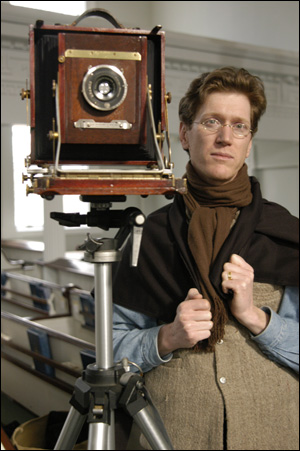
About the Author
Stephen Longmire is a photographer and writer currently based in the Adirondacks whose work focuses on the history and politics of place. His photographs are in the permanent collections of the Corcoran Gallery of Art, National Park Service, and Grinnell College’s Faulconer Gallery. Longmire has written on photographic art for a wide range of publications, including Afterimage, The Chicago Reader, DoubleTake, and The Wilson Quarterly, and he has taught the history and practice of photography at Yale University, Georgetown University, and Columbia College Chicago. In 2010, he was awarded a Ph.D. by the University of Chicago for his pioneering study of the “phototexts” of Wright Morris, the acclaimed novelist and photographer from Nebraska. In his first book, Keeping Time in Sag Harbor (Center for American Places, 2007), Longmire explored the effects of the nation’s last real estate boom on his hometown of Sag Harbor, New York, a storied whaling port turned summer resort near the fashionable Hamptons. That book earned the praise of the award-winning novelist E. O. Doctorow, who wrote: “Stephen Longmire has an eye for the glories of an historic village—the way its past endures in its doorways, its gravestones, its fences, its finials. This lovely and loving book, attesting to the unorganized acts of preservation that have maintained the truth of a place for 300 years, is itself a scrupulous act of preservation.” His Website is www.stephenlongmire.com.
ABOUT THE ESSAYISTS
Diana Horton, Ph.D, from 1983 until her retirement in 2010 was a professor of biology at the University of Iowa. From 1983 to 2004 she was also Director and Curator of the University of Iowa Herbarium, until that plant library was transferred to Iowa State University. Dr. Horton is a plant taxonomist with a specialty in bryophytes. Her exhaustive list of plants found at Rochester Cemetery established the cemetery as among the most biologically diverse prairie remnants in the Midwest.
Aaron Wolf is a documentary filmmaker based in New York City, where he opened Urban Rustic, a grocery/cafe specializing in local foods. Woolf’s 2007 film, King Corn, chronicles the year he spent on an Iowa farm and the contradictions of contemporary agriculture. His documentary on the future of Detroit, Beyond the Motor City, aired on the Public Broadcasting Service (PBS) in 2010.
Slide Show


Praise
“This moving and sensitive photo essay captures both the beauty of Rochester Cemetery—one of the finest surviving prairie savannas in the whole United States—and its powerful meaning to the people of this tiny township in eastern Iowa as the resting place of their ancestors. Here, as Stephen Longmire writes, deep prairie roots and the bodies of prairie pioneers lie ‘locked in a long embrace.’ And here, in pictures and text, is a suitably beautiful meditation on the paradoxes of this ‘conservation conundrum’ where ‘underworld and heavens meet.'”
—Robert F. Sayer, editor of Recovering the Prairie


“There are places in our landscapes, and in our experience, where we have unique opportunities to connect—across generations and boundary lines, across perspectives and ideas. Rochester Cemetery, tucked away quietly within the great but vanquished landscape of the American tallgrass prairie, is one of those special places. It is not an especially expansive or sublime place by typical standards. Its power derives not from its size or its scenery but from its story as a surviving remnant of our continent’s grasslands, its human and natural communities mingling in intimate relationship. Through his words and images, Stephen Longmire takes us to Rochester Cemetery and shares that story. We come to see that, even if we never visit this rare piece of native Iowa, of native America, something deep inside us still rests, and grows, and renews itself there.”
—Curt Meine, author of Aldo Leopold: His Life and Work


“After spending time with this wonderful book, I feel I have been allowed to see a private place of uncommon beauty and ecological complexity. What a rare discovery, yet Rochester Cemetery only seems a discovery to the outsider. The local people have buried their dead here since 1832, and they revisit its oaks and grassy hillsides, finding spots for contemplation as the prairie holds their lost ones in its quiet and profuse beauty. Stephen Longmire has given close attention to understanding this place through his photography and his research into its history. I feel privileged to share its beauty through this book.”
—Terry Evans, author of The Inhabited Prairie


“Stephen Longmire’s book highlights certain life and death struggles of Iowa: its prairie heritage, its people, and its communities. Through wonderful landscape photographs, first-hand accounts, and research we can glimpse the trials and tribulations of a small piece of Iowa and its history.
“The focus of Longmire’s book is the Rochester Cemetery (also known as the Rochester Prairie), situated in east-central Iowa in Cedar County. It is one of the most bio-diverse prairie remnants in the state. An impressive 337 regionally native plants out of a total of 400 species of plants have been recorded here…
“Like other pioneer cemeteries across the state of Iowa and the nation, the Rochester Prairie fights to survive. This book examines the factors contributing to the maintenance of native plant communities in cemeteries in our modern world. With its beginnings following white settlement in 1832, the Rochester Cemetery, its people, and its prairie have witnessed the changing attitudes of each generation. The author does a wonderful job of intertwining the rich history of the area through text and images…
“It’s a small miracle that this special and sacred piece of land still announces life anew, with each spring inspiring bursts of white and pink shooting stars. This plant once was common across the Iowa prairie and is now a rare indicator of a time in Iowa’s not-so-distant past when buffalo roamed and Iowa was yet to be surveyed and platted. The author’s landscape scenes beautifully depict the cemetery and its amazing journey through the seasons.
“Many of our pioneer cemeteries and graveyards with sections established in the 1880s have prairie beneath them, but one rarely gets to see which survivors are still present. Our society desires manicured grass and tidy appearances. Is it possible that more cemeteries across Iowa could follow in Rochester’s footsteps and try a more soft-handed approach to care and upkeep? Wouldn’t it be wonderful to see what would grow on the edges of cemeteries or around the oldest markers? Life and death are connected inherently: life and death of an Iowa prairie and its creatures, life and death of the settlers who came and turned over sod, life and death of early towns and settlements, and the life and death of every one of us. And yet the prairie survives—somehow growing anew with each and every year. The Rochester Cemetery demonstrates to us through the ages what is important. It reminds us of our past and shows us what our future holds.”
—Michele Olson, from her book review in Wapsipinicom Almanac, Volume 18 (2012)
