

$60.00 U.S. (trade discount)
No e-book has been authorized.
Hardcover (two volumes) with slipcase
248 pages with 126 color and
20 duotone photographs by the author
8.25″ x 11.5″ (upright/portrait)
ISBN: 978–1–938086–32–8
Published in March 2016
Distributed by Casemate/IPM
www.casemateipm.com
No e-book has been authorized.
Events and Exhibitions
September 21, 2018 at 2 p.m.
Erika Diettes will give a presentation on her work Relicarios/Reliquaries
The Latin American Library’s 11th Annual Open House
March 14 – May 19, 2018
‘Reliquaries’ exhibit
Memoria Haroldo Conti Cultural Center, Buenos Aires, Argentina
March 1 – April 11, 2017
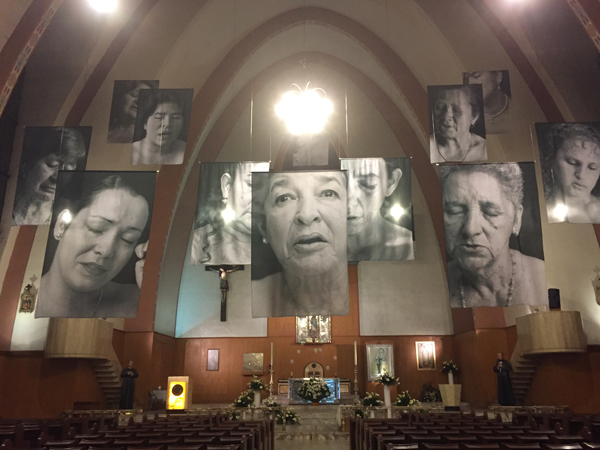
Lannan Foundation sponsored show of Erika Diettes ‘Sudarios: Shrouds’ and ‘Rio Abajo/Drifting Away’ at the cathedral Parroquia Verbo Encarnado y Sagrada Familia in Mexico City.

Monday, March 28, from 6-8 pm
Houston Center for Photography
Conversation between Erika and Anne Tucker, followed by book signing
(English/Spanish bilingual edition)
Photographs and text by Erika Diettes
Essay by Ileana Diéguez
(translated by Rowan Ricardo Phillips with Becky Ortiz)
Interview with the Photographer by Anne Wilkes Tucker
(translated by Becky Ortiz)
The 2017 Tim Hetherington Fellowship is awarded to Erika Diettes!
Memento Mori: Testament to Life is a poignant tribute to the victims of Colombia’s armed conflict that has claimed more than 250,000 people during the last fifty years. The book is presented as four bodies of photographic work in a two-volume, bi-lingual edition: English and Spanish.
The first volume includes hauntingly beautiful images of Diettes’s photographic work on display at museums and at memorials in areas where the victims “disappeared,” a moving statement by the artist herself, an essay by Mexican scholar Ileana Diéguez, and an extensive conversation with the artist by Anne Wilkes Tucker, former Curator of Photography at the Museum of Fine Arts, Houston.
The second volume showcases the plates from three photographic series: Sudarios (Shrouds), photographs printed on linen of women who have witnessed atrocities committed against their loved ones, Río Abajo (Drifting Away), images of articles of clothing of “the disappeared,” photographed in water and embedded in glass, and Relicarios (Reliquaries), three-dimensional works of polymer containing mementos and personal effects of the victims.
At once majestic, accessible, and deeply moving, this book makes a significant contribution not only to documentary art, contemporary Latin American studies, and social anthropology but also to those wanting to understand, at a very basic level, the human cost of terrorism. As Anne Wilkes Tucker writes, Erika Diettes’s unforgettable book speaks “of universal loss from violent death.” And it is through her art that we learn how to grieve from such loss.

About
About the Author
Erika Diettes is a Colombian visual artist and social anthropologist who explores issues of memory, pain, absence and death in a variety of mediums. Her work has been exhibited in unique spaces linked to re-memoration processes developed by the victims’ movements in Colombia, as well as at other venues including the Museums of Modern Art of Bogotá, Cali, Medellín, and Barranquilla in Colombia; the Museum of Contemporary Art in Santiago de Chile, at the Museum of Fine Arts and the Fotofest Biennal in Houston, the Festival de la Luz in Buenos Aires, the Ballarat Foto Biennale in Australia, the Malta Festival in Poznań, Poland, and at CENTER in Santa Fe, New Mexico. Her work is part of the permanent collection of the Museo de Antioquia (Colombia) and the Museum of Fine Arts Houston.
About the Essayists
Ileana Diéguez, PhD is a research professor in the Humanities and Social Sciences Department at Universidad Autónoma Metropolitana (UAM) in Mexico City, where she works on issues of modern and performing arts, as well as the processes pertaining to performativity and disassembly. She has curated exhibitions on these themes in Mexico and South America, and is the author of several books including Cuerpos sin duelo. Iconografías y teatralidades del dolor/Bodies Without Mourning. Iconographies and Theatricalities of Pain (Document A, 2013), and Escenarios Liminales. Teatralidades, performances y política/Liminal Stages/Scenarios. Theatricalities, Performances and Politics (Atuel 2011).
Anne Wilkes Tucker is the former Gus and Lyndall Wortham Curator of Photography at the Museum of Fine Arts, Houston. From 1976, when she founded the Department of Photography at MFAH, until her retirement in June 2015, she organized or co-organized more than forty exhibitions of photography, including retrospectives on Brassaï, Louis Faurer, Robert Frank, George Krause, Ray K. Metzker, Richard Misrach, and, most recently, “WAR/PHOTOGRAPHY: Images of Armed Conflict and its Aftermath,” and expanded the museum’s photographic holdings from 141 images to more than 29,000, representing work by some 4,000 artists from all seven continents. In 2001, she was named America’s best curator by TIME magazine.
Slide Show


Praise
“Some artists are by vocation gravediggers. Much of Erika Diettes’s work can be regarded as the fabric of an extensive and intimate shroud with which to wrap, consecrate, bid farewell, and provide a final resting place for bodies not yet laid to rest… . Despite the dark background from which [the photographs] emerge, these images project a kind of radiance in that they transmit the agony of an era and accounts of life in that era.”
— Ileana Diéguez, from “Erika Diettes: Images in Mourning”
Read a review of Diettes’s work, Relicarios, on ArtLink
How Art on Catholic Campuses Compliments Students’ Education
My Place
My place is a location inside me that has been assembled as various geographic locations throughout the world have impacted my existence. It is an amalgam of the places where I have lived for a long while or spent significant time. These experiences so shape my sense of place that I try to live fully from day to day, with the signatures of those places influencing my life in every way.
Assateague Island, off the coast of Maryland, is where I spent many days as a young person. When I was five and six years old, it was where my father took me hunting and fishing and where we searched for the remains of old ship wrecks, once finding a brass dinner bell and a brass ship’s compass in the sand dunes that constitute the eastern side of the island. We also watched the wild horses romp on the western side of the island and attended the annual “pony penning” roundup during which the wild horses were swum across the channel to Chincoteague Island, our “next-door neighbor” in Virginia.
My life in Florida after the age of six also centered on water and big sky. We lived in the town of Lake Wales. All year long we were in or on the waters of lakes with names such as Lake Wales, Weohyakapka, Rosalie, Okeechobee and hanging out as teenagers at the Camp Mack Fish Camp on Lake Kissimmee. The lakes and rivers in Florida are fed by springs bubbling up from the underground Floridan aquifer through the karst system of lime rock. Many of the rivers are tea-colored or “blackwater” rivers, which derive their color from leaf tannins staining the clear waters. Others flow from springs whose volume is so great that they remain crystal clear, such as the Ichetucknee and Crystal rivers.
Currently, I live on the Santa Fe River just to the north of High Springs, Florida, a “really great” town. The Santa Fe flows southwest above ground and underground through the lands just north of Gainesville until its waters mingle with those of the Suwannee River and continue to the Gulf of Mexico. Because the Santa Fe’s waters are fed by several major springs along its way, it sometimes is crystal clear and at other times it is tea-colored. The Santa Fe is always beautiful, with mysterious swallets swirling water back down into the aquifer and springs surging waters upward toward the surface. It provides excellent habitat for eagles, hawks, herons, limpkins, osprey, storks, swallowtails, woodpeckers, numerous other small-bird species, and water rats like my neighbors and me. Its waters abound with fish, turtles, snakes, and alligators. The shoreline features plants and trees of semi-tropical and upland forest varieties, but wild magnolia trees and crowning cypress trees are its hallmarks.
Before rediscovering my love for Florida along the Santa Fe River ten years ago, I found and lived for more than three decades in a glorious refuge of place in the countryside north of Davidson, North Carolina. I resided, worked, played, and loved in three nineteenth-century log structures that I renovated and assembled (with help!) on the land. The land there slopes sharply down to a creek. It is heavily wooded with beautiful beech trees interspersed with hickory, oaks, tulip poplars, and sourwood trees. Part of the rolling hills of the Piedmont, this land is augmented by outcroppings of large granite rocks, rivers and streams. The Town of Davidson is home to Davidson College and has the advantages of a small college town with a great coffee shop in between a marvelous bookstore and ice cream shop. Just opposite these establishments is the Town Green, where, on almost every weekend, there is some festival, concert, or fund-raiser for a worthy cause such as the Run for the Green, a marathon sponsored by the Davidson Lands Conservancy. Saturdays in Davidson feature the farmers’ market, specializing in local organically produced products.
These places have been “homes” where I have nested for deep periods of time. Others places have made significant impacts on my sense of place as well, but in short sprints of time by way of foreign travel. Time spent in Japan during the 1960s forever changed how I think about a sense of aesthetic as applied to all of life. Time spent in India since the 1970s has changed how I viewed humanity and how we benefit when we perceive each other from a broader perspective. With these layers of experiences, I have grown to feel that, ultimately, “my place” resides within and that it is not an external environment. Still, I love the beauty to be found in the people and plants and critters and places that surround us, for through place can be found a gateway, a threshold, to the inner soul where our “true” place resides and grows.
Copyright © 2013 Martha Strawn. All rights reserved.