

$60.00 U.S. (trade discount)
E-book TBD.
Hardcover/PLC with jacket
416 pages with 264 plein-air paintings by the author and 1 color map
10.0″ x 11.0″ (upright/portrait)
ISBN 978–1–938086–41–0
Published in November 2016
Distributed by the The University of Virginia Press
www.upress.virginia.edu
Events and Exhibitions
December 8, 2018
Book signing, exhibit tour and opening
December 8, 2018 – Sept. 1, 2019
Virginia Museum of History & Culture
Richmond, VA (more info here)
Read an interview with Kushnir in the museum’s magazine (pdf).
Read an article about the exhibit here.
October 18, 2018
Book talk and signing (more info here)
Massanutten Regional Library, Harrisonburg, VA
November 29, 2017 from 5:30-8 p.m.
Book Signing at the Annual Book Fair
The University Club of Washington, DC
Monday May 1, 2017 from 5-7 p.m.
Opening Reception
Exhibition runs through June 23rd
JMU’s Duke Hall Gallery of Fine Art
Read “Scenic Shenandoah” an article from the Daily News Record (pdf)

Map by Morgan Pfaelzer.
by Andrei Kushnir
with a foreword by Dana Hand Evans, essays by Warren R. Hofstra and William M. S. Rasmussen, historical vignettes by Jeffrey C. Everett, and an afterword by Edward L. Ayers
Kushnir and Everett won the 2020 Award Excellence in Preservation from the Shenandoah County Historical Society.
The Shenandoah Valley is one of the most revered places in America and even the world. Mention it to anyone or say you live there, and the response is invariably, “Oh, it is so beautiful!” Images of its scenic beauty have resonated throughout its history, and even today it is seen as a modern-day idyllic landscape of farms and fields, historic towns and Civil War battlefields, framed on the east and west by the majestic and colorful Blue Ridge and Allegheny Mountains and defined, as well, by the river made famous in the 1882 song, “Oh, Shenandoah.”
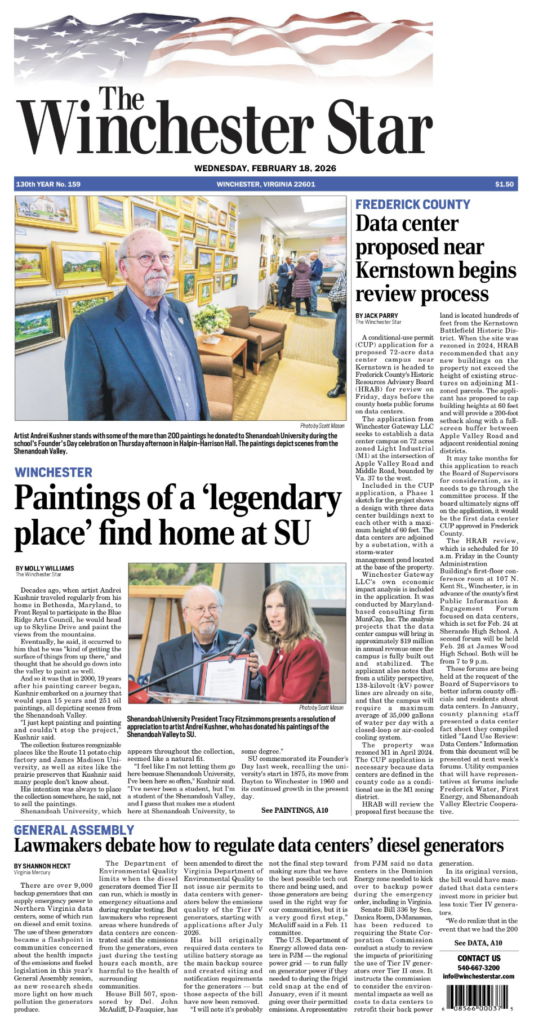
Andrei Kushnir, a well-known and highly regarded painter in the Washington, D.C., area, has spent nearly a decade traveling throughout every corner of the Shenandoah Valley, painting its myriad landscapes and architectural features with panache and an extraordinary appreciation for place. Kushnir has that rare ability to paint any landscape before him—pastoral or industrial, recreational or social, rural or urban, riparian or agricultural—all the while working out in the elements, en plein air. No artist has ever captured the Shenandoah Valley and its famous river so comprehensively, so intuitively, as has Andrei Kushnir.
In addition to Kushnir’s 264 plein-air paintings that are featured for the first time in this book, Oh, Shenandoah presents in-depth essays by leading experts—Edward L. Ayers, Dana Hand Evans, Jeffrey C. Everett, Warren R. Hofstra, and William M. S. Rasmussen—who add a rich, contextual element about the Valley’s history and geography and Kushnir’s significant contribution to our understanding of this special place. This book, which complements landmark exhibitions of Kushnir’s Valley paintings at the Museum of the Shenandoah Valley and James Madison University, is a publication that will endure for generations to come.
Video: Artist, Andrei Kushnir returns to Mississippi to discover more about his early childhood.
Video: Andrei Kushnir Talks Painting the Valley at Shenandoah
Shenandoah Today, Shenandoah University News and Events
About

About the Author
Andrei Kushnir grew up in Mississippi and Chicago. Always interested in art, he was a cartoonist for The Chicago Illini, the student newspaper of the University of Illinois at Chicago, and has been a full-time painter since 1980 with a particular focus on the American landscape rendered en plein air (painting out of doors). He is particularly well known for his plein air paintings of the Potomac River and C&O Canal, both near his Maryland home, but he has also painted throughout the United States, particularly Virginia’s Shenandoah Valley and Crooked Run Valley; the shorelines of Maine, New York, Cape Hatteras, and Florida’s Gulf Coast; Colorado, New Mexico, and Arizona; and New Zealand, Italy, and the Netherlands.
His works have been exhibited widely in numerous juried and invitational shows throughout the United States, often selected by judges who were curators at major art museums. His paintings are in the permanent collections of the Virginia Historical Society, U.S. Coast Guard, University of Maryland, Museum of Florida’s Art and Culture, and District of Columbia’s Commission of Arts and Humanities, among others. And the artist has had solo exhibitions at the Virginia Historical Society, where he was the first living artist accorded such an exhibit; Taylor and Sons Fine Art, of Washington, D.C.; Rehoboth (Delaware) Art League; Museum of the Shenandoah Valley, Winchester, VA, where, in 2016, he was the first living artist accorded such an exhibit; Museum of Florida’s Art and Culture, South Florida State College, Avon Park, FL; James Madison University’s Duke Gallery of Fine Art; and Capitol Hill Art League, Washington, D.C.
Kushnir is a signature member of the National Oil and Acrylic Painters Society, and he is also an elected member of the Washington Society of Landscape Painters, of Washington, D.C., and the Salmagundi Club, of New York City. He is a member of Oil Painters of America and the Blue Ridge Arts Council, of Front Royal, Virginia. He is also an Official U. S. Coast Guard Artist.
Kushnir is the author of seven publications of his work: Oh, Shenandoah: Paintings of the Historic Valley and River (2016), River Visions (2013), Painted Seasons (2010), Potomac River School (2009), Painted History (2004), American Light (2001), and My River (1999). Kushnir’s paintings have also appeared in Rock Creek Park (2003) and Along the Potomac: Images of America (2000). Articles about Kushnir and his work have been published in The Washington Times, The Washington Post, The Register Guard (Oregon), The Nature Conservancy Magazine, The Montgomery Gazette (Maryland), The Longboat Observer (Florida), The Journal (West Virginia), Hill Rag (Washington, D.C.), Highlander Today (Florida), The Gloucester Matthews Gazette Journal (Virginia), The Gasparilla Gazette (Florida), and élan Magazine (Virginia), among others.
About the Essayists
Edward L. Ayers is the Tucker-Boatwright Professor of the Humanities and President Emeritus of the University of Richmond. He is the author and editor of eleven books, among them The Promise of the New South: Life after Reconstruction (1992), a finalist for the National Book Award and Pulitzer Prize, and In the Presence of Mine Enemies: War in the Heart of America, 1859–1863 (2003), which won the Bancroft Prize.
Dana Hand Evans is Executive Director of the Museum of the Shenandoah Valley who, previously, was Executive Director (2002–2011) of the Wilton House Museum and the National Society of the Colonial Dames of America in the Commonwealth of Virginia.
Jeffrey C. Everett has been a leading land conservation and historic preservation consultant since 1994 who has researched and documented thousands of historic buildings and landscapes for the Virginia Department of Historic Resources, among many other accomplishments.
Warren R. Hofstra is the Stewart Bell Professor of History at Shenandoah University and the author, editor, and co-editor of six books, including The Planting of New Virginia: Settlement and Landscape in the Shenandoah Valley (2004) and The Great Valley Road: Shenandoah Landscapes from Prehistory to the Present (2010).
William M. S. Rasmussen is Lead Curator and Lora M. Robins Curator of Art at the Virginia Historical Society and the author and co-author of eight books, among them Old Virginia: The Pursuit of a Pastoral Ideal (2003) and The Virginia Landscape: A Cultural History (2002).
Slide Show


Praise
“Oh, Shenandoah is one of the most visually stunning and informative books of its kind that I’ve ever had the pleasure to own. The 264 plein-air masterworks of Andrei Kushnir form, of course, the centerpiece; he has captured our beloved Shenandoah Valley with a level of love and skill that few artists are capable of exhibiting. The book’s accompanying essays by leading experts also provide Oh, Shenandoah with an educational component that helps make this handsomely appointed volume a must-own for anyone who loves art, history, or that great and wonderful area the Indians called ‘The Daughter of the Stars.'”
—Charles Culbertson, historian and columnist, The News Leader
“In the late summer of 2008, Andrei Kushnir braved brush, thorny vines, tall grass and whirling insects in order to capture in a painting a particularly beautiful scene of the Shenandoah River. The Washington, D.C., artist set his easel up in a woodsy spot at Red Banks, where the North Fork of the river flows. The oil painting graces the front cover of his just-released book, Oh, Shenandoah: Paintings of the Historic Valley and River. The large volume contains 263 plein-air paintings that Kushnir created during a nearly decade-long project that took him the length and breadth of the world-famous valley. Little escaped his artistic attention. As one might expect, the book is replete with scenic views. But there also are paintings such as Evening in Brownsburg, which transforms a quiet, house-lined street into a masterful work of art.”
—David A. Maurer, Pulse (read the full article here)


“Andrei Kushnir’s landscape paintings of the Shenandoah Valley express an atmosphere and texture that can only be achieved by the artist standing in and subjecting himself to the scene that he paints. Through his use of color and superb brushwork, he is able to realistically create his experience of the Valley’s many moods—from the warm, sultry days of summer to the cool, clear days of spring and fall. Kushnir’s oil paintings take us on a wonderful and intimate journey through a truly magnificent place on Earth. Through careful observation of his work, it is easy to experience what he has experienced—to feel the wind and hear the birds and insects that reside just beneath the surface of his paintings.”
—Gary Freeburg, Professor of Art and Director of the James Madison University Duke Hall Gallery of Fine Art
“Andrei Kushnir’s plein-air paintings of the Shenandoah Valley’s most iconic lands and built environments evoke the past and awaken a sense of history and memory. But look again. These shimmering paintings also witness very specific lived moments in real time. As Kushnir skillfully records fleeting daylight colors, seasons, and details of contemporary life, it is clear that he is painting a Shenandoah Valley we live in now—alive and vital, history ongoing. Paired with equally rich contextual essays, these paintings invite readers to share the artist’s unique vision while beckoning us to get out of the car, too, perhaps with brush or camera in hand, and explore that landscape ourselves.”
—Scott Jost, author of Shenandoah Valley Apples and Professor of Art, Bridgewater College
“The essence of a place—its geography and history—resides in its landscapes. The Shenandoah Valley is an extraordinary theater of natural features and human constructions rich in imagery and interpreted for us anew in this wonderful book by Andrei Kushnir. His luminous and insightful plein-air paintings—all 264 of them!—capture moments in time and character in a manner that invites the reader to experience the Valley’s extraordinary and ordinary places. The varied perspectives, along with astute essays and vignettes by leading experts, encourage us to see the Shenandoah Valley’s essential character as never before.”
—Karl B. Raitz, co-editor of The Great Valley Road of Virginia: Shenandoah Landscapes from Prehistory to the Present and Professor of Geography Emeritus, University of Kentucky
“History…mystery…mythology…the words wrap themselves sensuously around the single lyrical name ‘Shenandoah.’ The place that bears a name spirited from a long-forgotten tongue has shape shifted over time. In Oh, Shenandoah, the magnificent paintings of Andrei Kushnir, accompanied by the softly woven essays about settlement, geography, and natural history, create a tapestry of joy in the discovery of Shenandoah’s many changing faces.”
—Nancy T. Sorrells, historian and co-author of Virginia’s Cattle Story: The First Four Centuries
“The Shenandoah Valley is one of America’s great places, on par with the Grand Canyon and New York City. Its grandeur derives neither wholly from nature nor human achievement but rather from a sublime harmony between the two. Andrei Kushnir’s plein-air paintings of the Valley radiate its natural beauty. Look closer, and you’ll also see the light of the human spirit—cooperation, resourcefulness, and an abiding reverence for the land and its seasonal rhythms. In a word: hope.”
—Logan Ward, author of the Shenandoah Valley memoir, See You in a Hundred Years: One Family’s Search for a Simpler Life
“I had the realization that Andrei’s work is as good as all these 19th and 20th century paintings we revere,” he explains, referring to works by Rockwell Kent, Edward Beyer and other artists. “The Shenandoah Valley is the epitome of the American melting pot and these paintings allow us to tell the history and geography of the region. It’s unusual to be able to do that much teaching in an art show.”
—Bill Rasmussen, senior curator of exhibitions, Virginia Museum of History and Culture, as reported by Karen Newton of Style Weekly (read full article here)
Read a review in the Maine Antique Digest. (pdf)
Read a review in the Richmond Times-Dispatch. (jpg)
My Place

During the past thirty-five years, I have chased after (and found!) the most inspiring, beautiful, pastoral, historic, and scenic places in the United States and, indeed, the world, and I have enjoyed every minute of the adventure. But the place that has the greatest amount of stimulus for my mind, soul, and body remains Manhattan’s East Village. This ancient tract of New York City real estate—rough, decrepit, often primitive but also bustling and vibrant—is an unending source of discovery and surprise. While I grew up in another great city, Chicago, which I also love for many of the same reasons, and I immensely enjoy Toronto, my wife’s home town, New York City is simply over the top, bursting with eye-candy, food for the soul and belly, historical provenance, glitz, gore, guile, and material abundance, glamor and decay. And the East Village area seems to be the shabby black top hat from where all this emanates (or disappears into).

My first exposure to the East Village was yearly visits during the 1980s and 90s with my two closest high school/college buddies, Bohdan and George, who by then lived in nearby Connecticut and New Jersey. Because of our shared Ukrainian heritage, the three of us would meet at the Veselka Ukrainian-style restaurant on lower 2nd Avenue for a hearty breakfast before setting out to spend a “guys’ day out” visiting record stores, liquor stores, and souvenir emporiums on St. Marks Place. Once, after I parked my car, an old wino approached and tried to show me something, but I waved him off without even looking at him. George, who had just parked across the street (on early Saturday and Sunday mornings, it was still possible to find a side-street parking space), ran up to me and joked that I was truly heartless—I wouldn’t help the man open the screw top to his bottle of cheap wine! After a breakfast of blintzes, eggs, kielbasa, and other delights, we would spend the days rummaging through the new and used record shops. Tower Records was a truly magnificent palace of the newest sonic sounds, but small used-record shops such as Finyl Vinyl could hold obscure recordings familiar from our youthful days in Chicago. We once saw Meryl Streep there, who declined a request for an autograph because she was “off duty.” We would check for the newest brands of Ukrainian vodka and other libations in the plethora of liquor stores then tucked in the area. There were shops that sold big and small guns and knives, exotic clothing, strange kitchen utensils, and pure kitsch. The window shopping was really just an excuse to spend time together, reminiscing about the past, opining on the latest movies, and just plain “hanging out.” Filled with exotic sounds and smells, the East Village was the perfect place to do that: over-ripe bananas from the fruit carts, grease from greasy spoons, and deliriously yummy aromas from the halal gyro stands. People on the street seemed to model their own unique styles: a transvestite man dressed as the Virgin Mary, urban cowboys, ersatz gypsies, aging hippies—you get the point.
photograph is by Sveta Driga
In 2004, along with another artist, Michele Martin Taylor, I opened an art gallery on East 6th Street between 2nd and 3rd Avenues. My brothers, Wally and Tony, helped in sprucing the space up, good naturedly shaking their heads about how the area was “rough stuff.” Several of our artist friends participated by showing their paintings there and providing camaraderie. Michele moved into the same building as the gallery and ran the place, while I hauled paintings from my home base in Maryland and Washington, D.C. for a monthly change of shows during the next five years. I found that I could drive up before noon, redo the gallery during the afternoon, catch a fantastic burger at “Paul’s, Da Burger Joint,” and be back home by 2 a.m. It was grueling at times but also exhilarating, always worth the trip to an environment so disturbing and jangling yet pulsing with ethnic street music, off-color conversations, and moms calling their kids in for dinner in Polish or Spanish. Michele painted in the gallery, made friends with local clients and collectors (including Blondie’s biographer), various art enthusiasts who turned out to be really thoughtful and well educated critics, and who got acquainted with other East Village artists such as Joachim Marx, with whom she went on watercolor painting expeditions.

Occasionally, I would drive up and bunk down in the gallery, have breakfast at Ray’s Pizza and Bagel Cafe on 3rd Avenue, and then go out into the streets to paint the scene all day long. Interestingly, the Finyl Vinyl used-record store, in the same building as the gallery, went defunct (the story was that the owner just locked up one day and never came back), and we moved the gallery into that space since it had its very own bathroom. The building superintendent (the “Supe”) told us it had been a (drug) shooting gallery in the 60s. Many movies and television programs were made in our immediate area, and it wasn’t unknown for lights and extras to cluster around the gallery’s door step. It was great for Michele and her artist friends, because they could get in line and get breakfast off the rolling kitchen at the studio’s expense.

While we never came close to becoming millionaires, we were able to pay our bills, thanks to the patronage of just enough art lovers from all over Manhattan who recognized the sincerity of our respective works. I did miss an opportunity to make a fortune by not grinding out paintings of McSorley’s Old Ale House, located across the way on 7th Street. The three paintings that I created sold quickly, one before it even got to the city. I had visited McSorley’s many times with my pals George and Bohdan and on many subsequent occasions during the art gallery project. The bar’s cheese-and-onion platter, served with a pack of saltines, was always a favorite of mine—what better accompaniment to a couple of brews?!
One of my most memorable nights in the East Village was one Halloween eve, while Michele was out of town visiting her twin brother, Mike, on the West Coast. My wife, Rae, and I stayed in Michele’s apartment, took a taxi to Midtown to catch a Broadway musical, and then walked back from 42nd Street along Broadway. It was a warm, beautiful evening, and people in exotic, funny, and often impressive costumes darted about, laughing and cavorting under the streetlamps.

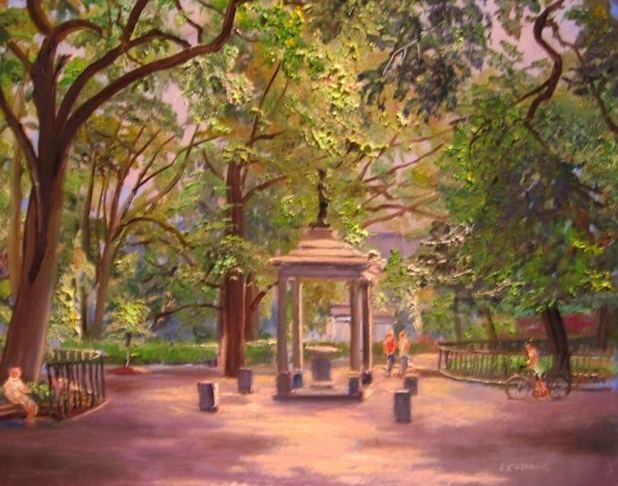
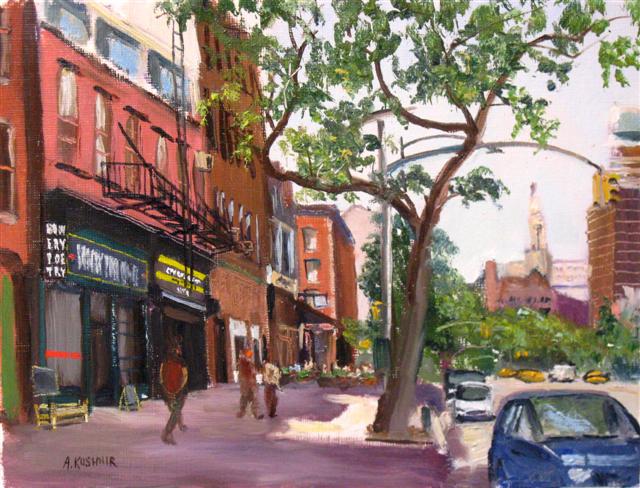
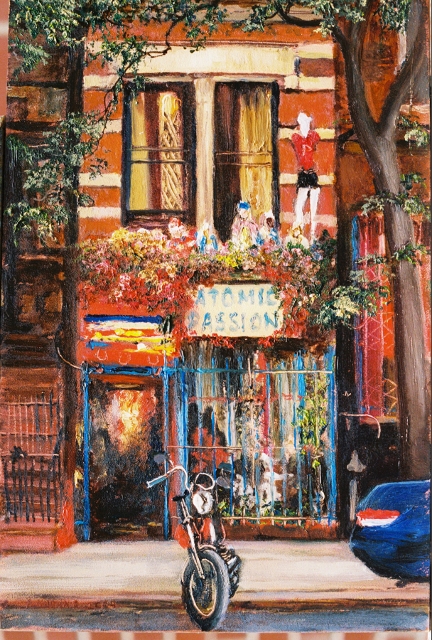
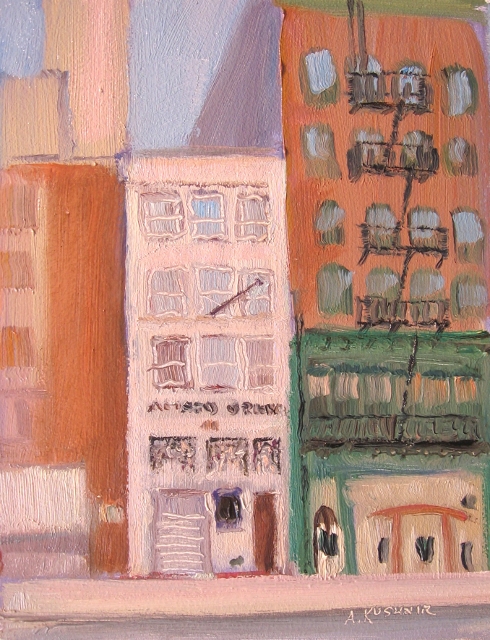
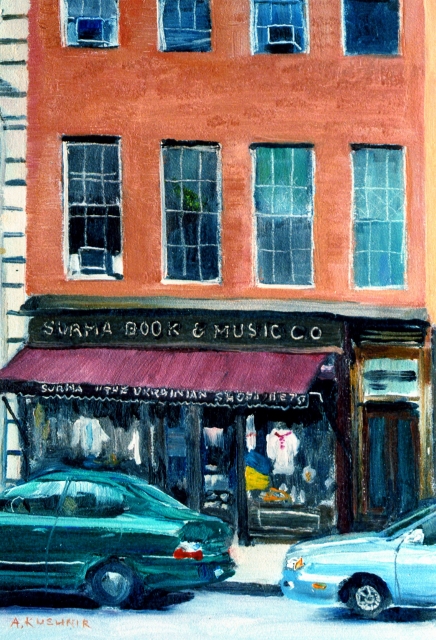
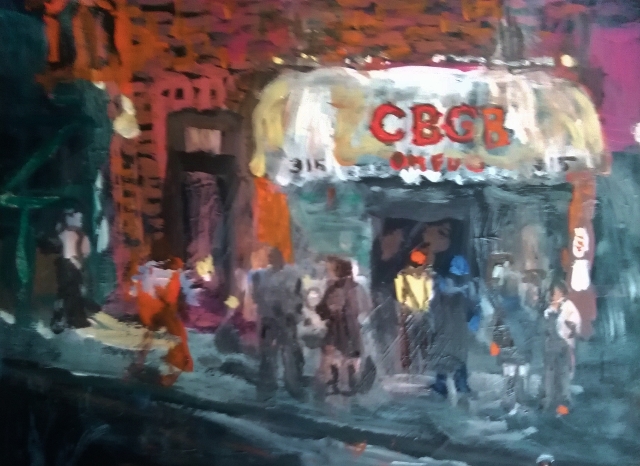
After the gallery closed, on Michele’s decision to move back to Portland, Oregon, I took yearly painting trips to the East Village, staying with an artist friend, David Baise, who lived in a six-floor walk-up on East 5th Street. He had come to New York as a teenager after winning an award for painting and simply stayed there, caught in the electricity of the place, and was still there on the same block 50 years later. David provided me with accommodations that fit in with the character of his small, cluttered apartment: I slept on a small trampoline with my legs resting on a Toyota car seat. David’s place was on the same block as the 9th Precinct police station. Because it is across the street from a playground, that station was used in many NYC-based police shows so that viewers would be aware of its neighborhood situation. I painted views of nearby Curry Row, Thompkins Square Park, the Bowery Poetry Club, Atomic Passion (a novelty shop), the Amato Opera, the Surma Ukrainian Book and Music shop (where Karen Allen acquired the Ukrainian-style blouse she wore in Raiders of the Lost Ark), CBGB, and many other venues of distinction (or not). Sadly, many of the shops disappeared shortly after they were memorialized in these paintings.

The East Village is still there in all of its seedy glory. An art-client friend confessed that it was the one place his parents warned him about most vehemently when he was growing up. But now you can order a $25 martini cocktail before ambling down the street to visit the New Museum. Or you can order a fish taco at the B Bar and Grill, still there, and eat in their garden, near the Bowery on East 4th Street, or catch the musical STOMP at the Orpheum Theater. Or you can just walk aimlessly around, like so many others, catching the essence of what makes New York City’s East Village the real-life exemplification of unfettered imaginations. After all these years and experiences, I feel as though I am still a part of the scene.
Unless otherwise noted, all paintings are by Andrei Kushnir.
Copyright © 2018 Andrei Kushnir. All rights reserved. Copyright to images of all paintings reserved to the respective artists.