

$45.00 U.S. (trade discount)
No e-book has been authorized.
Hardcover with jacket
96 pages with 56 color photographs by the author
14.0″ x 9.5″ horizontal/landscape
ISBN: 978–1–938086–06–9
Published Fall 2012
Distributed by Casemate/IPM
www.casemateipm.com
Events and Exhibitions
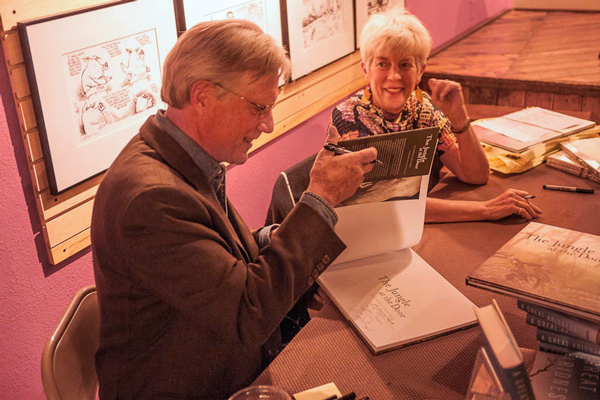
September 2012: Collected Works Bookstore, Santa Fe, New Mexico. Joan Myers and William deBuys book signing.
Exhibition
September 26 – October 15, 2012
Andrew Smith Gallery, Santa Fe, New Mexico
Santa Fe Radio Cafe Interview
(click to listen to the podcast)
by Joan Myers
with an introduction by William deBuys
Like millions of other children worldwide, Joan Myers was inspired at an early age by Rudyard Kipling’s stories and books about the jungles of India. And, so, given the opportunity to visit wildlife refuges in India, she jumped at the chance. The Jungle at the Door is the result of that experience.
Through the miracle of photography and the beholding eye of a master photographer such as Myers, we are able to experience the land and life in India’s last remaining wild jungles. This is the land of the tiger and elephant and monkey and rhino and a treasure trove of other species. But, as noted writer William deBuys shares in his provocative essay, poaching is a persistent and pervasive problem, and the natural habitat for wild animals is shrinking at an alarming rate due to expanding development and industrialization. Tigers, for example, are now extinct in ninety-three percent of their historical range worldwide, and, without wildlife refuges such as Bandhavgarh, Kanha, Karizanga, and others in India, their numbers would plummet further.
Few citizens of the world will ever experience firsthand the jungles and wild places of India, but in Myers’s visual discovery they can witness the excitement and energy of coming upon wild game in a moment’s notice and experiencing religious shrines and rural life in nearby villages that seem to blend in effortlessly with the adjacent wilderness.
The Jungle at the Door is that rare glimpse into another world, a world that depends not only on human awareness of what is lost when the jungle is gone, but also the courage and foresight to preserve remaining wild places everywhere, from those in India to our own home ground.
About
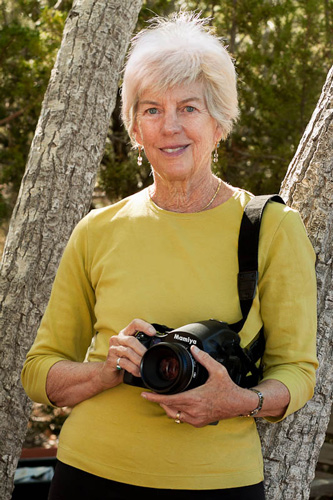
About the Author
Joan Myers was born in Des Moines, Iowa, in 1944, and she has spent a lifetime learning and exploring. At Stanford University, her concentration on Renaissance and baroque music led to a B.A. and M.A. in musicology in 1966 and 1967, but, during the early 1970s, Myers turned to photography as her life’s work, beginning as a large-format platinum-palladium printer but today primarily shooting and printing digitally. Her photographs have appeared in more than fifty solo and eighty group exhibitions throughout the United States, and they are included in the permanent collections of the Amon Carter Museum, Bibliothèque Nationale de France, Center for Creative Photography, Denver Art Museum, George Eastman House International Museum of Photography, High Museum of Art, Minneapolis Museum of Art, Museum of Fine Arts, Houston, Museum of Modern Art, Nevada Museum of Art, and San Francisco Museum of Modern Art, among others. In 2002, the National Science Foundation awarded Myers a prestigious Antarctic Artists and Writer’s Grant to photograph at McMurdo Station, surrounding field stations, historic huts, and the South Pole. That resulted in a major traveling exhibition and accompanying book, Wondrous Cold: An Antarctic Journey (Smithsonian Books, 2006), which won an Honorable Mention from the American Association of Museum’s 2006 Publications Competition. Her other books include Pie Town Woman (New Mexico, 2001), which was the Best Illustrated Book for 2001 from Publishers Association of the West, Salt Dreams: Land and Water in Low-Down California, with William deBuys (New Mexico, 1999), which won both the 1999 Western States Book Award for Nonfiction and the 1999 William P. Clements Prize for the Best Nonfiction Book on Southwestern America, Whispered Silences: Japanese Americans and World War II (Washington, 1996), which earned the Rocky Mountain Booksellers Award and an Honorable Mention from Maine Photographic Workshops, Santiago: Saint of Two Worlds (New Mexico, 1991), and Along the Santa Fe Trail (New Mexico, 1986). Her Website is www.joanmyers.com.
About the Essayist
William deBuys was born and raised in Maryland. He completed his undergraduate work, suma cum laude, at the University of North Carolina at Chapel Hill in 1972 and his M.A. and Ph.D. in American civilization at the University of Texas in Austin in 1982. DeBuys has long been active in conservation and environmental affairs, and his efforts have led to the permanent protection of more than 150,000 acres of wild lands in North Carolina and New Mexico alone. As a writer, deBuy’s shorter work has appeared in DoubleTake, High Country News, Northern Lights, New York Times Book Review, and Orion, among other periodicals and anthologies. His books include A Great Aridness: Climate Change and the Future of the American Southwest (Oxford, 2011), The Walk (Trinity, 2007), an excerpt from which won a Pushcart Prize in 2008, Valles Caldero: A Vision for New Mexico’s National Preserve (Museum of New Mexico Press, 2006), which won a Southwest Book Award, Seeing Things Whole: The Essential John Wesley Powell (Shearwater/Island Press, 2001), Salt Dreams: Land and Water in Low-Down California, with Joan Myers (New Mexico, 1999), which won the 1999 Western States Book Award for Nonfiction and the 1999 William P. Clements Prize for the Best Nonfiction Book on Southwestern America, River of Traps, with Alex Harris (New Mexico, 1990; Trinity, 2008), which was a New York Times Notable Book of the Year and a finalist for the Pulitzer Prize in General Nonfiction in 1991 won by E. O. Wilson, and Enchantment and Exploration: The Life and Hard Times of a New Mexico Mountain Range (New Mexico, 1985), which won a Southwest Book Award and is now in its ninth printing. His Website is www.williamdebuys.com.
Slide Show
Kipling’s jungle stories were some of my favorite reading as a small child. I would turn the pages on my illustrated edition, even before I could read the words, looking at the drawings of the boy who lived with wolves and played with a panther and a bear. The jungle of the Jungle Books and Just So Stories is rapidly vanishing: the spectacularly beautiful birds, the elephants, both wild and tame, the rhinoceros, the wild boar, the deer, and monkeys. Of more than 40,000 tigers that prowled the forests in the beginning of the twentieth century, only a few thousand remain. Extensive poaching has reduced their numbers; their valuable skins are prized, and their teeth, claws, and other body parts are used in Chinese medicine and exotic recipes. Wildlife refuges have helped slow the decline, but their borders are easily breached by poachers, and India’s expanding population needs roads and services. In losing the tiger and the jungle, we lose part of the primitive, mysterious wildness that has long been part of our human psyche. Seeing a tiger in the wild is a rare and special gift. I fear that, with their numbers steadily decreasing, it is unlikely that my grandchildren will have the opportunity I had to see a tiger in Kipling’s forest. Through this book I hope to provide readers and viewers the opportunity to see these wild jungles and animals and to share with them my excitement and joy at experiencing these endangered places.


Praise

“At once familiar and a revelation, immediate and distant, Joan Myers’s photographs show a world in which the great beasts and humans, nature and the gods still co-exist, but William deBuys’s passionate and prophetic words warn of the velocity with which that fragile coexistence is being reduced to urban myth.”
—Gita Mehta, filmmaker and author of Karma Cola: Marketing the Mystic East and Snakes and Ladders: Glimpses of Modern India
“Joan Myers has moved calmly from photographing the Antarctic to the jungles of India, bringing that place to our door with subtle intimacy, immersing us in a dense and misty world while offering unexpected glimpses of its wildlife and other secrets.”
—Lucy R. Lippard, author of The Lure of the Local: Senses of Place in a Multicentered Society
“It is in these photographs, serendipitous moments captured by her lens, that Myers’ work evokes that long-ago world of Shere Khan, the tiger, Mowgli, the “man cub” raised by wolves; and other characters from Kipling’s classic. “The whole set of images has a feeling that’s magical.””
—Michael Abatemarco, The New Mexican, Pasatiempo
(click to download the full article here)

“The Jungle at the Door: A Glimpse of Wild India by Joan Myers and William deBuys is a large-format book of Myers’s photography and writing and an essay by deBuys about a wild place few travelers get to visit. The large-format, full-color images are mystical in quality and seem to be more a work of an artist’s water-color paintbrush than a photograph, partially because an early morning mist sort of dissolves some of the landscapes and the jungle itself makes the animals sometimes difficult to spot, only creating a mystery that draws the viewer in. The writing in the book is illusional as well and creates a beautiful mood for appreciating the photographs, which include rare human sightings of animals which prefer to stay hidden, like the white elephant and the Indian tiger. You will appreciate every page of this book and return often to peruse it. A lovely coffee table or gift book.”
—Bonnie Neely, owner of Real Travel Adventures and book reviewer for Amazon

“Send a master photographer like Joan Myers into the jungles of the Indian subcontinent and you will be treated to superbly crafted images of a vanishing wilderness and the wealth of life it gave support to. Enhanced with an informative essay by William deBuys, The Jungle at the Door is a 96-page hardcover, coffee-table book showcasing full-color photographs of wild places that will be forever lost when the jungle is no more due to the encroachments of human activity—including climate change—upon wildlife habitats. A beautifully composed and superbly presented collection, The Jungle at the Door is a highly recommended addition to personal, community, and academic library photography reference collections.”
—James A. Cox, Editor-in-Chief, Midwest Book Review

“This book documents the photography of Joan Myers in the wildlife refuges of India. Myers is a American photographer whose work appears in major museum collections and award-winning books. Most of the book consists of full-page photographic reproductions, printed without comment. Each is identified in a rear index where a small reproduction of each image is accompanied by information giving the location of the picture and identifying any animals that appear. The only text is a thoughtful and eloquent essay by Pulitzer Prize-nominated author William deBuys, who writes often on conservation topics. Myers’s photographs are evocative as art and more deeply informative than many images; she allows readers to see the natural blur or crispness of motion and atmosphere, and animals appear at their natural scale within scenes that will surprise viewers used to the close-up photography of animals in studios and zoos. The major presences that inhabit these photographs are the landscapes in which wild animals, people, and livestock appear, materializing through the greenness as astonishing and solid ghosts.”
—Eithne O’Leyne, Editor, ProtoView, Ringgold, Inc.
“Through the miracle of photography and the beholding eye of a master photographer such as Myers, we are able to experience the land and life in India’s last remaining wild jungles. This is the land of the tiger and elephant and monkey and rhino and a treasure trove of other species. But, as noted writer William deBuys shares in his provocative essay, poaching is a persistent and pervasive problem, and the natural habitat for wild animals is shrinking at an alarming rate due to expanding development and industrialization. Tigers, for example, are now extinct in ninety-three percent of their historical range worldwide, and, without wildlife refuges such as Bandhavgarh, Kanha, Karizanga, and others in India, their numbers would plummet further.
Few citizens of the world will ever experience firsthand the jungles and wild places of India, but in Myers’s visual discovery they can witness the excitement and energy of coming upon wild game in a moment’s notice and experiencing religious shrines and rural life in nearby villages that seem to blend in effortlessly with the adjacent wilderness.
Jungle at the Door is that rare glimpse into another world, a world that depends not only on human awareness of what is lost when the jungle is gone, but also the courage and foresight to preserve remaining wild places everywhere, from those in India to our own home ground.
Off the beaten track in the backwaters and jungles of India – like watching a film documentary. Stunning photographs…”
—Books Monthly UK
My Place
Tesuque, New Mexico, where I’ve lived for thirty years, means “village of the narrow place of the cottonwood trees” in the Tewa language of the native pueblo just across the highway. I love the road through our little community, which is shaded by overhanging cottonwoods and reminds me of the great oaks and elms I grew up with in Des Moines, Iowa.
This land is high desert, frequently snow-covered in winter and sometimes hot in the summer. There is rarely enough rain, though we do have frequent thunderstorms during the summer that make the earth smell raw and clean. Visitors to the small pond outside my studio’s window include coyotes, foxes, rabbits, and a variety of local and migratory birds. I keep binoculars and a bird book on my desk. Often, when I need a break from the computer, I sit outdoors in a weather-worn redwood chair, feel the sun on my face, and gaze up at the Santa Fe ski basin to the east or at Los Alamos in the Jemez Mountains to the west.


I feel fortunate to live where I can walk out of my yard and hike for miles up into the Sangre de Cristo Mountains, the southernmost subrange of the Rockies. Listening to bird-songs and being sheltered by mountains on both sides is a comforting reassurance of stability on an increasingly unstable planet, and walking is a soothing antidote to the distractions of technology. When I want cultural activity, Santa Fe with its multitude of options—concerts, gallery openings, literary readings, theater, dance, and film―is only a ten-minute drive away. I’m always struggling to balance the outdoors and the arts, home and travel, work and family. Living in New Mexico helps me do that.
Home includes my husband, Bernie and, not too far away, one of my sons, his wife, and two grandsons. The rest of our extended family live elsewhere but return here for frequent visits. At this time we have no pets, since we travel frequently. If I need to clear my mind and open my eyes, a one-day drive in any direction will serve my purpose and provide photographic opportunities. It’s exciting to travel to places as unfamiliar as India or Antarctica, but home is always best.
Copyright © 2013 Joan Myers. All rights reserved.