
$30.00 U.S. (short discount)
No e-book has been authorized.
Softcover with gatefold flaps
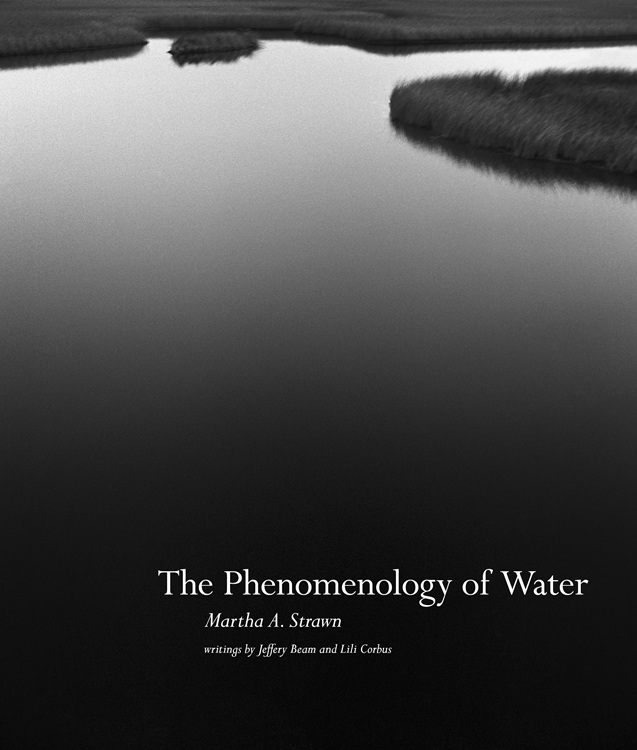
37 photographs by the author and one photograph of the author by Michael Mauney = 38 illustrations
8.0″ x 10.0″ upright/portrait
ISBN: 978-1-960521-21-7
Forthcoming October 2026
Distributed by Casemate/IPM
www.casemateipm.com
Published in association with the
Center for the Study of Place.
ABOUT AUTHOR
PRAISE
SLIDE SHOW
MY PLACE
Events and Exhibitions
November 1, 2026
Opening Reception
The Phenomenology of Water
upstairs [artspace]
Book Information Sheet (pdf)
by Martha A. Strawn
with a poem by Jeffery Beam and an essay by Lili Corbus
A stunning and beautiful book about water and its many meanings!
For more than sixty years, artist-photographer Martha Strawn has traveled throughout the United States and the world, making unforgettable photographs about water that enrich our sense of place and consciousness. Whether standing along a lake, river, seashore, pond, or estuary, Strawn seeks the essence of what she sees and expands our notion of what water means.
The Phenomenology of Water features thirty-six of Strawn’s timeless photographs, some in color and others in black-and-white. Each is a work of art. Some images are expansive, showing water within the larger landscape, whereas others are intimate if not ephemeral. No matter what the view, Strawn’s photographs of water connect the outer world and the inner self, and they suggest an abiding responsibility for sustaining the quantity and quality of water. As Indigenous people everywhere have long proclaimed: “Water is life.”
Strawn’s photographs reflect her deep interest in the kinship between art and science, what she calls “visual ecology.” Whether in her native South or in Africa, Alaska, Asia, Canada, Central America, the Middle East, or New Zealand, she personally engages with water to comprehend its elemental connection to the “soul” and our conscious existence. In her photographs the visible layers of water become metaphors for the different realms of reality that are perceived by human consciousness no matter where one lives.
Collected here for the first time in this book that also serves as a companion to an exhibition similarly entitled “The Phenomenology of Water,” Strawn’s photographs are enhanced by her personal introduction and coda as well as a captivating poem by award-winning writer Jeffery Beam, an insightful essay by noted art historian Lili Corbus, and suggested readings. Curators have already declared that the book will be an enduring contribution. As Jason Steuber, Director of the Appleton Museum of Art, declares: “This life-affirming book welcomes the reader to view, learn, and remember water’s importance to all humanity as the life-giving force that binds us all together. It highlights Strawn’s exceptional career as an artist, teacher, and mindful conservationist.”
About
About the Author
Martha A. Strawn taught at the University of North Carolina, Charlotte from 1971 until her retirement as Professor of Art Emerita in 2006, and she has long been recognized for combining aesthetic and scientific inquiries into the study of place that she calls visual ecology. She co-founded The Light Factory Contemporary Art Museum of Photography in Charlotte, was the first woman to be Chair of the Board of Directors of the Society for Photographic Education (SPE), and was a Fulbright Fellow to India and a National Endowment for the Arts Fellow in Photography.
Her photographs have been exhibited in and collected by museums worldwide, including the Indira Gandhi National Centre for the Arts, Smithsonian Institution, Princeton Art Museum, National Geographic Society Museum, Mint Museum of Art, Carnegie Museum of Natural History, and Appleton Museum of Art. She is the author of Alligators, Prehistoric Presence in the American Landscape (Johns Hopkins University Press, in association with the Center for American Places, 1997), co-author with Yi-Fu Tuan of Religion: From Place to Placelessness (Center for American Places, 2009), author of Across the THRESHOLD of India: Art, Women, and Culture (George F. Thompson Publishing, 2016), and editor of Flight of Spirit: The Photographs of Anne Noggle (Museum of New Mexico Press, 2019).
Strawn lives and works in High Springs, Florida, and in Tryon, North Carolina, with her husband, William T. Latham. She has worked in the southern United States for most of her career while working intermittently in India for more than forty years and in other places for shorter periods of time, including Egypt, Japan, Kenya, Portugal, and Tanzania. She has served as President of the Anne Noggle Foundation since 2007 and Vice President of the Center of the Study of Place since 2015, and she co-founded and serves as an advisor to Our Santa Fe River and David Land conservancies in Florida and North Carolina, respectively.
Strawn is currently engaged in completing a long personal project of connecting water and consciousness that represents her emotional bond and mental awareness with the place of water and light in our conscious framework as humans. Her Website is www.MarthaStrawn.art.
About the Contributors
Jeffery Beam is a poet whose work, hailed for its “transcendent, lush beauty, its minimal sacrament, simplicity and physicality,” fuses the physical and spiritual worlds, creating a conversation between the natural world, the body, and the spirit. He is the author of more than twenty-five books, including Verdant (Kin Press, 2022), The New Beautiful Tendons (Spuyten Duyvil, 2012), and Visions of Dame Kind (Jargon Society, 1995). His CD multimedia collection, What We Have Lost: New & Selected Poems, won an Audio Publishers Award. Collaborations with visual artists, composers, and musicians are an important characteristic of his work, and these have taken him to Carnegie Hall, Italy, and Wales. These partnerships include Spectral Pegasus with Welsh painter Clive Hicks-Jenkins and An Elizabethan Bestiary: Retold, illustrated by Ippy Patterson, which was honored with the American Institute of Graphic Arts 50 Books/50 Covers award and designated one of ten “Outstanding Books of the Year” in 2000 by the Independent Publisher Book Awards (IPPYS). Musical works inspired by his poems have also been performed across Europe and North America, and Troubadour: Collaborations & Inventions in Music 1971–2023 was published in conjunction with a Mallarmé Music concert, celebrating Beam’s seventieth birthday and the composers who have set his poems to music. Ceramicist Judith Ernst’s two large vessels carved with his poems are now in the permanent collections of the Mint Museum in Charlotte, North Carolina and Blowing Rock Art & History Museum in Blowing Rock, North Carolina. Beam, is a retired botanical librarian at the University of North Carolina, Chapel Hill, the Poetry Editor Emeritus of Oyster Boy Review. At UNC-Chapel Hill, and has received awards for public service and preservation, including being named the campus’s Lorax for his efforts in preserving its historic landscape and trees. UNC-Chapel Hill’s Special Collections holds his archive, with smaller collections at the ONE Library in Los Angeles and Fort Lauderdale’s Stonewall National Museum. His Website is www.jefferybeam.com.
Lili Corbus is Associate Professor of Art History Emerita from the University of North Carolina, Charlotte. She previously taught at Ohio University and the University of Montana before joining the faculty at the University of North Carolina, Charlotte, in 1993. She enjoyed teaching nineteenth-century, modern, and contemporary art history as well as courses in women’s and American studies. She has lectured internationally and published widely, including articles, exhibition catalogues, and a well-received book on social documentary, Photography and Politics: From the New Deal into the Cold War (Johns Hopkins University Press, in association with the Center for American Places, 1999), for which George F. Thompson served as her editor. Reviewer James L. Enyeart wrote that it “set a new standard for books in the history of photography.” Corbus has focused extensively on women photographers, including Rosalie Gwathmey, Sonia Handelman Meyer, Anne Noggle, and Bayard Wootten as well as other artists and topics such as Louie Palu, John Biggers, circus imagery, and wedding photography for History of Photography, Studies in American Culture, Journal of Black Mountain College Studies, The Southern Quarterly, Studies in Popular Culture, and more. She has also published interviews with the many artists she talked to over the years, including John Cage and Aaron Siskind. Subjects for exhibits she has curated include the Photo League, mid-twentieth-century photography in the Bank of America collection, and earth art, among other diverse areas. After she retired from the University of North Carolina, Charlotte, in 2006, Corbus continued to be an active independent scholar. She is now based in western North Carolina, lecturing, researching, publishing, and curating. One of her current projects is a book-in-progress, Dolls in Art, a subject she has photographed and studied for some forty years.
Praise
“The Phenomenology of Water is a stunning book about the most ordinary of substances. Like photographs themselves, water is, in Strawn’s hands, neither fully surface nor inhabitable depth. Each turn of the page moves with fluidity as she crafts a wondrous testament to this fundamental element and its mysterious, ever-changing character.”
—Allison Grant, Associate Professor of Art at the University of Alabama, Guggenheim Fellow in Photography, and author of Within the Bittersweet
“In the Taoist tradition, water embodies seven virtues symbolizing transformation and balance. In Martha Strawn’s photographs, water ripples, ebbs, and flows through our collective subconscious. Her camera captures the beauty of the water spirits dancing beneath the surface, casting dreamlike reflections. Whether evoking calm or chaos, the images echo this ever-moving substance. Strawn’s photographs connect the world’s waterways through global watersheds, reminding us that we all live downstream. The Phenomenology of Water is as beautiful as it is inspiring: Fall in love with the world with new eyes.”
—Mary Anne Redding, Senior Curator, The Turchin Center for the Visual Arts at Appalachian State University
“The Phenomenology of Water is a meditation on seeing. In these compelling photographs, water is not simply observed; it is entered, contemplated, remembered, and felt. Spanning six decades, Martha Strawn reveals water as mirror, threshold, memory, and source.”
—Mark Sloan, Retired Director and Chief Curator of the Halsey Institute of Contemporary Art and co-author of Southbound: Photographs of and about the New South
“Martha Strawn’s The Phenomenology of Water brings together more than six decades of studying that what has been always linked to her creative DNA—water. She is a water person through and through. Strawn has traveled the world many times over photographing it, meditating about it, writing about it, and working to preserve and conserve it. This life-affirming testimonial book welcomes the reader to view, learn, and remember water’s importance to all humanity as the life-giving force that binds us all together. It highlights Strawn’s exceptional career as an artist, teacher, and mindful conservationist.”
—Jason Steuber, Director of the Appleton Museum of Art and editor of China: A Celebration in Art and Literature and Collectors, Collections, and Collecting the Arts of China: Histories and Challenges
“Most of us know water when it runs from a faucet, is carried in a bottle, or flows down our drains. Domestic water changed how many of us live, no longer requiring us to carry it from a river, creek, spring, or well. It’s something we’ve come to expect when we want it and ignore when we don’t. A few seek a more elemental experience of water, a firsthand immersion in its wild state, swimming its currents, paddling its lengths, and exploring beneath its surface. That is what Martha Strawn has done in her captivating retrospective book, The Phenomenology of Water, showing us wild water in various states from a personal perspective and inviting the viewer to join her.”
—Janet L. Pritchard, Professor of Art at the University of Connecticut, Chair of the Board of Directors of the Society for Photographic Education, Guggenheim Fellow in Photography, and author of More than Scenery: Yellowstone, an American Love Story
“The Phenomenology of Water is an extraordinary publication that accompanies the exhibition of the same name. In this book, the artist-photographer Martha Strawn articulates—clearly and eloquently—the many layers of deep meaning and the feeling of reverence that water has for her, both personally and aesthetically. The images are further enhanced by the marvelous poem by Jeffery Beam that matches in words the beauty of the photographs, and Lili Corbus in her essay skillfully places Strawn’s work in art historical context and analyzes the unique stylistic elements that explain, as she puts it, why ‘Strawn’s eye does not disappoint.’”
—Sarah Schroth, Director Emerita, Nasher Museum of Art at Duke University
Slide Show


My Place
My place is a location inside me that has been assembled as various geographic locations throughout the world have impacted my existence. It is an amalgam of the places where I have lived for a long while or spent significant time. These experiences so shape my sense of place that I try to live fully from day to day, with the signatures of those places influencing my life in every way.
Assateague Island, off the coast of Maryland, is where I spent many days as a young person. When I was five and six years old, it was where my father took me hunting and fishing and where we searched for the remains of old ship wrecks, once finding a brass dinner bell and a brass ship’s compass in the sand dunes that constitute the eastern side of the island. We also watched the wild horses romp on the western side of the island and attended the annual “pony penning” roundup during which the wild horses were swum across the channel to Chincoteague Island, our “next-door neighbor” in Virginia.
My life in Florida after the age of six also centered on water and big sky. We lived in the town of Lake Wales. All year long we were in or on the waters of lakes with names such as Lake Wales, Weohyakapka, Rosalie, Okeechobee and hanging out as teenagers at the Camp Mack Fish Camp on Lake Kissimmee. The lakes and rivers in Florida are fed by springs bubbling up from the underground Floridan aquifer through the karst system of lime rock. Many of the rivers are tea-colored or “blackwater” rivers, which derive their color from leaf tannins staining the clear waters. Others flow from springs whose volume is so great that they remain crystal clear, such as the Ichetucknee and Crystal rivers.
Currently, I live on the Santa Fe River just to the north of High Springs, Florida, a “really great” town. The Santa Fe flows southwest above ground and underground through the lands just north of Gainesville until its waters mingle with those of the Suwannee River and continue to the Gulf of Mexico. Because the Santa Fe’s waters are fed by several major springs along its way, it sometimes is crystal clear and at other times it is tea-colored. The Santa Fe is always beautiful, with mysterious swallets swirling water back down into the aquifer and springs surging waters upward toward the surface. It provides excellent habitat for eagles, hawks, herons, limpkins, osprey, storks, swallowtails, woodpeckers, numerous other small-bird species, and water rats like my neighbors and me. Its waters abound with fish, turtles, snakes, and alligators. The shoreline features plants and trees of semi-tropical and upland forest varieties, but wild magnolia trees and crowning cypress trees are its hallmarks.
Before rediscovering my love for Florida along the Santa Fe River ten years ago, I found and lived for more than three decades in a glorious refuge of place in the countryside north of Davidson, North Carolina. I resided, worked, played, and loved in three nineteenth-century log structures that I renovated and assembled (with help!) on the land. The land there slopes sharply down to a creek. It is heavily wooded with beautiful beech trees interspersed with hickory, oaks, tulip poplars, and sourwood trees. Part of the rolling hills of the Piedmont, this land is augmented by outcroppings of large granite rocks, rivers and streams. The Town of Davidson is home to Davidson College and has the advantages of a small college town with a great coffee shop in between a marvelous bookstore and ice cream shop. Just opposite these establishments is the Town Green, where, on almost every weekend, there is some festival, concert, or fund-raiser for a worthy cause such as the Run for the Green, a marathon sponsored by the Davidson Lands Conservancy. Saturdays in Davidson feature the farmers’ market, specializing in local organically produced products.
These places have been “homes” where I have nested for deep periods of time. Others places have made significant impacts on my sense of place as well, but in short sprints of time by way of foreign travel. Time spent in Japan during the 1960s forever changed how I think about a sense of aesthetic as applied to all of life. Time spent in India since the 1970s has changed how I viewed humanity and how we benefit when we perceive each other from a broader perspective. With these layers of experiences, I have grown to feel that, ultimately, “my place” resides within and that it is not an external environment. Still, I love the beauty to be found in the people and plants and critters and places that surround us, for through place can be found a gateway, a threshold, to the inner soul where our “true” place resides and grows.
Copyright © 2013 Martha Strawn. All rights reserved.