

$34.95 U.S. (trade discount)
E-book TBD.
Softcover with gatefold flaps
116 pages with 86 plein-air paintings by the author, 1 book cover, and
4 maps = 91
10.5″ x 8.5″
ISBN 978–1–960521–00–2
Published in July 2024
Distributed by the The University of Virginia Press
www.upress.virginia.edu
Published in association with the
Center for the Study of Place.
Events and Exhibitions
February 24, 2025 from 7-8
Exhibit opens and author/artist talk
Woodrow Wilson Presidential Library
November 2, 2024 from 5-7 PM
Official Book Launch
American Painting Fine Art, Washington, DC
June 1, 2024 from 5-7 PM
The Shenandoah Valley’s Interstates exhibition opening
American Painting Fine Art, Washington, DC

by Andrei Kushnir
with an introduction by Warren R. Hofstra
2025 Next Generation Indy Book Award Finalist for best book in the Art category
Most people travel through the beautiful and historic Shenandoah Valley lickety-split by way of its interstates: I-81 but also I-66 and I-64. In looking out the window, drivers can see why the Valley is world-renowned for its scenery and diverse landscapes. Andrei Kushnir since 2001 has been rendering the Shenandoah Valley through his revered plein-air paintings—that is, paintings made out of doors and on site. In 2016, his acclaimed book, Oh, Shenandoah: Paintings of the Historic Valley and River, was published, featuring 264 original paintings by the artist as well as informative essays about the Valley’s history and culture.
As a complement to that now-classic book, Kushnir has done what no artist at any time anywhere has ever done: paint the landscapes of and along any interstates, much less the three in the Shenandoah Valley. Here, he has created a remarkable new book, featuring 86 of his paintings, revealing why I-81 in the Shenandoah Valley has for decades been proclaimed as one of America’s most scenic interstates. The book is introduced by noted historian Warren Hofstra, who deftly explains how the Shenandoah Valley became famous and why I-81 is but the newest version of the historic “Valley Road”: from its origin as an Indian path to the Valley Pike during the eighteenth and nineteenth centuries and then U.S. 11 in the twentieth. Andrei Kushnir’s book will be cherished by Valley residents and passersby alike. It will also serve as a clarion call to other plein-air painters to render their regional interstates with their creative work.
About

About the Author
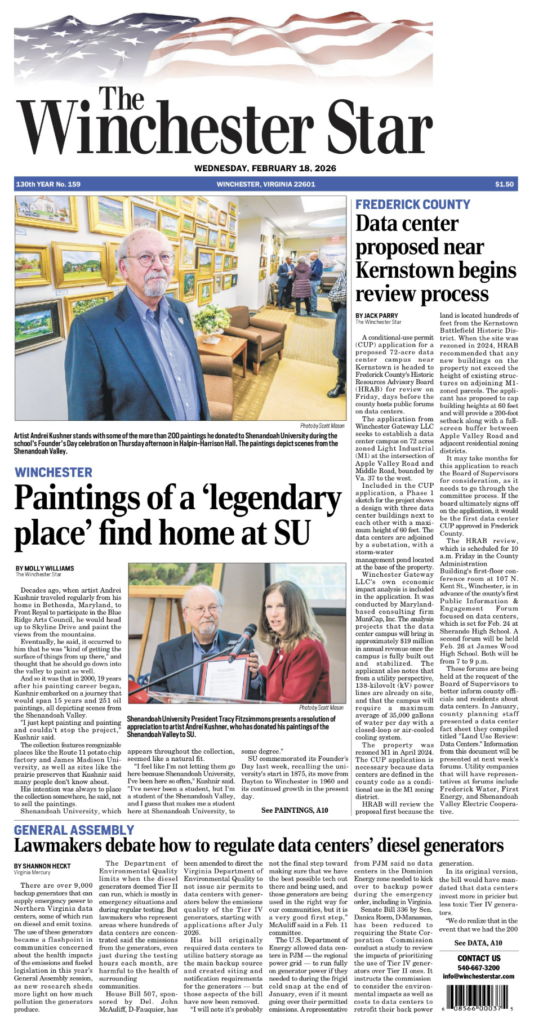
Andrei Kushnir has painted in oils since 1980, with a focus on the American landscape rendered en plein air (painting out of doors). He is well known for his plein-air paintings of the Potomac River and C&O (Chesapeake and Ohio) Canal, both near his home in Maryland, but he has painted throughout the United States, particularly Virginia’s Shenandoah Valley and Crooked Run Valley; the shorelines of Maine, New York, Cape Hatteras, and Florida’s Gulf Coast; Colorado, Idaho, Mississippi, New Mexico, and Arizona; and New Zealand, France, Italy, and the Netherlands. His paintings have been exhibited widely in numerous juried and invitational shows throughout the United States, often selected by judges who were curators at the Corcoran Gallery of Art, Hirshhorn Museum, National Gallery of Art, and National Museum of American Art, all in Washington, D.C. The artist’s paintings are also in the permanent collections of the Virginia Museum of History and Culture (formerly the Virginia Historical Society); U.S. Coast Guard; University of Maryland University College, College Park; Museum of the Shenandoah Valley; Museum of Florida’s Art and Culture; and District of Columbia’s Commission of Arts and Humanities, among others. His paintings also hang in the Ukrainian Embassy in Washington, D.C., and are in the private collections of former Presidents George W. Bush of the U.S. and Viktor Yushchenko of Ukraine. And he also had exhibitions at the Virginia Museum of History and Culture, where he was the first living artist accorded such an exhibit; University Club, of Washington, D.C.; Taylor and Sons Fine Art, of Washington, D.C.; Rehoboth (Delaware) Art League; Museum of the Shenandoah Valley, where, in 2016, he was the second living artist accorded such an exhibit; South Florida State College Museum of Florida’s Art and Culture, in Avon Park, FL; James Madison University’s Duke Gallery of Fine Art; and Capitol Hill Art League, of Washington, D.C.
Kushnir was elected a signature member of the National Oil and Acrylic Painters Society, and he is also an elected member of the Washington Society of Landscape Painters in Washington, D.C.; Salmagundi Club, of New York City; Miniature Painters, Sculptors and Gravers Society, of Washington, D.C., where he served as a vice president; and an artist member of Oil Painters of America; Capitol Hill Art League; Blue Ridge Arts Council, of Front Royal, Virginia; and Alexandria and Fairfax, Virginia, Art Leagues. He has also served as an Official U.S. Coast Guard Artist.
Kushnir is the author of nine publications of his work: Painted Boca Grande (2020), Blue Ridge Paintings (2017), Oh, Shenandoah: Paintings of the Historic Valley and River (2016), River Visions (2013), Painted Seasons (2010), Potomac River School (2009), Painted History (2004), American Light, 2001 (2001), and My River (1999). Kushnir’s paintings have also appeared in Rock Creek Park (2003) and Along the Potomac: Images of America (2000). Stories about Kushnir’s paintings have been heard on Voice of America and been published in The Washington Post, The Washington Times, The Register Guard (Oregon), The Nature Conservancy Magazine, The Montgomery Gazette (Maryland), The Longboat Observer (Florida), The Journal (West Virginia), Hill Rag (Washington, D.C.), Highlander Today (Florida), The Gloucester Matthews Gazette Journal (Virginia), The Gasparilla Gazette (Florida), and élan Magazine (Virginia), among others.
About the Contributor
Warren R. Hofstra is the Stewart Bell Professor of History at Shenandoah University, where he has been a professor since 1978. In addition to teaching in the fields of American social and cultural history and directing the Community History Project of Shenandoah University, he has published more than fifty papers and written or edited nine books, including “Sweet Dreams”: The World of Patsy Cline (University of Illinois Press, 2013), Ulster to America: The Scots-Irish Migration Experience (University of Tennessee Press, 2011), The Great Valley Road: Shenandoah Landscapes from Prehistory to the Present, with Karl B. Raitz (University of Virginia Press, in association with George F. Thompson Publishing, 2010), and The Planting of New Virginia: Settlement and Landscape in the Shenandoah Valley (Johns Hopkins University Press, in association with the Center for American Places, 2004). His long-term research program focuses on the regional history of Virginia’s Shenandoah Valley as a field of inquiry in a large-scale investigation of American capitalism and material culture. He is also engaged in an effort employing immersive technology to present elements of the debate on electing the president at the Constitutional Convention of 1787 in a virtual reality format that draws participants into real-time experiential and learning environments and accounts for the creation of the electoral college.
Slide Show


Praise
My Place

During the past thirty-five years, I have chased after (and found!) the most inspiring, beautiful, pastoral, historic, and scenic places in the United States and, indeed, the world, and I have enjoyed every minute of the adventure. But the place that has the greatest amount of stimulus for my mind, soul, and body remains Manhattan’s East Village. This ancient tract of New York City real estate—rough, decrepit, often primitive but also bustling and vibrant—is an unending source of discovery and surprise. While I grew up in another great city, Chicago, which I also love for many of the same reasons, and I immensely enjoy Toronto, my wife’s home town, New York City is simply over the top, bursting with eye-candy, food for the soul and belly, historical provenance, glitz, gore, guile, and material abundance, glamor and decay. And the East Village area seems to be the shabby black top hat from where all this emanates (or disappears into).

My first exposure to the East Village was yearly visits during the 1980s and 90s with my two closest high school/college buddies, Bohdan and George, who by then lived in nearby Connecticut and New Jersey. Because of our shared Ukrainian heritage, the three of us would meet at the Veselka Ukrainian-style restaurant on lower 2nd Avenue for a hearty breakfast before setting out to spend a “guys’ day out” visiting record stores, liquor stores, and souvenir emporiums on St. Marks Place. Once, after I parked my car, an old wino approached and tried to show me something, but I waved him off without even looking at him. George, who had just parked across the street (on early Saturday and Sunday mornings, it was still possible to find a side-street parking space), ran up to me and joked that I was truly heartless—I wouldn’t help the man open the screw top to his bottle of cheap wine! After a breakfast of blintzes, eggs, kielbasa, and other delights, we would spend the days rummaging through the new and used record shops. Tower Records was a truly magnificent palace of the newest sonic sounds, but small used-record shops such as Finyl Vinyl could hold obscure recordings familiar from our youthful days in Chicago. We once saw Meryl Streep there, who declined a request for an autograph because she was “off duty.” We would check for the newest brands of Ukrainian vodka and other libations in the plethora of liquor stores then tucked in the area. There were shops that sold big and small guns and knives, exotic clothing, strange kitchen utensils, and pure kitsch. The window shopping was really just an excuse to spend time together, reminiscing about the past, opining on the latest movies, and just plain “hanging out.” Filled with exotic sounds and smells, the East Village was the perfect place to do that: over-ripe bananas from the fruit carts, grease from greasy spoons, and deliriously yummy aromas from the halal gyro stands. People on the street seemed to model their own unique styles: a transvestite man dressed as the Virgin Mary, urban cowboys, ersatz gypsies, aging hippies—you get the point.

photograph is by Sveta Driga
In 2004, along with another artist, Michele Martin Taylor, I opened an art gallery on East 6th Street between 2nd and 3rd Avenues. My brothers, Wally and Tony, helped in sprucing the space up, good naturedly shaking their heads about how the area was “rough stuff.” Several of our artist friends participated by showing their paintings there and providing camaraderie. Michele moved into the same building as the gallery and ran the place, while I hauled paintings from my home base in Maryland and Washington, D.C. for a monthly change of shows during the next five years. I found that I could drive up before noon, redo the gallery during the afternoon, catch a fantastic burger at “Paul’s, Da Burger Joint,” and be back home by 2 a.m. It was grueling at times but also exhilarating, always worth the trip to an environment so disturbing and jangling yet pulsing with ethnic street music, off-color conversations, and moms calling their kids in for dinner in Polish or Spanish. Michele painted in the gallery, made friends with local clients and collectors (including Blondie’s biographer), various art enthusiasts who turned out to be really thoughtful and well educated critics, and who got acquainted with other East Village artists such as Joachim Marx, with whom she went on watercolor painting expeditions.

Occasionally, I would drive up and bunk down in the gallery, have breakfast at Ray’s Pizza and Bagel Cafe on 3rd Avenue, and then go out into the streets to paint the scene all day long. Interestingly, the Finyl Vinyl used-record store, in the same building as the gallery, went defunct (the story was that the owner just locked up one day and never came back), and we moved the gallery into that space since it had its very own bathroom. The building superintendent (the “Supe”) told us it had been a (drug) shooting gallery in the 60s. Many movies and television programs were made in our immediate area, and it wasn’t unknown for lights and extras to cluster around the gallery’s door step. It was great for Michele and her artist friends, because they could get in line and get breakfast off the rolling kitchen at the studio’s expense.

While we never came close to becoming millionaires, we were able to pay our bills, thanks to the patronage of just enough art lovers from all over Manhattan who recognized the sincerity of our respective works. I did miss an opportunity to make a fortune by not grinding out paintings of McSorley’s Old Ale House, located across the way on 7th Street. The three paintings that I created sold quickly, one before it even got to the city. I had visited McSorley’s many times with my pals George and Bohdan and on many subsequent occasions during the art gallery project. The bar’s cheese-and-onion platter, served with a pack of saltines, was always a favorite of mine—what better accompaniment to a couple of brews?!
One of my most memorable nights in the East Village was one Halloween eve, while Michele was out of town visiting her twin brother, Mike, on the West Coast. My wife, Rae, and I stayed in Michele’s apartment, took a taxi to Midtown to catch a Broadway musical, and then walked back from 42nd Street along Broadway. It was a warm, beautiful evening, and people in exotic, funny, and often impressive costumes darted about, laughing and cavorting under the streetlamps.

After the gallery closed, on Michele’s decision to move back to Portland, Oregon, I took yearly painting trips to the East Village, staying with an artist friend, David Baise, who lived in a six-floor walk-up on East 5th Street. He had come to New York as a teenager after winning an award for painting and simply stayed there, caught in the electricity of the place, and was still there on the same block 50 years later. David provided me with accommodations that fit in with the character of his small, cluttered apartment: I slept on a small trampoline with my legs resting on a Toyota car seat. David’s place was on the same block as the 9th Precinct police station. Because it is across the street from a playground, that station was used in many NYC-based police shows so that viewers would be aware of its neighborhood situation. I painted views of nearby Curry Row, Thompkins Square Park, the Bowery Poetry Club, Atomic Passion (a novelty shop), the Amato Opera, the Surma Ukrainian Book and Music shop (where Karen Allen acquired the Ukrainian-style blouse she wore in Raiders of the Lost Ark), CBGB, and many other venues of distinction (or not). Sadly, many of the shops disappeared shortly after they were memorialized in these paintings.

The East Village is still there in all of its seedy glory. An art-client friend confessed that it was the one place his parents warned him about most vehemently when he was growing up. But now you can order a $25 martini cocktail before ambling down the street to visit the New Museum. Or you can order a fish taco at the B Bar and Grill, still there, and eat in their garden, near the Bowery on East 4th Street, or catch the musical STOMP at the Orpheum Theater. Or you can just walk aimlessly around, like so many others, catching the essence of what makes New York City’s East Village the real-life exemplification of unfettered imaginations. After all these years and experiences, I feel as though I am still a part of the scene.
Unless otherwise noted, all paintings are by Andrei Kushnir.


Copyright © 2018 Andrei Kushnir. All rights reserved. Copyright to images of all paintings reserved to the respective artists.