

$50.00 U.S. (trade discount)
No e-book has been authorized.
Hardcover with jacket
184 pages with 16 color and 57 duotone photographs
by the author and 33 historic black-and-white photographs
10.625″ x 8.5″ horizontal/landscape
ISBN: 978–1–938086–03–8
Published in Fall 2012
Distributed by Casemate/IPM
www.casemateipm.com
Events and Exhibitions
February 1-March 29, 2019 (Artist Reception: March 1)
“Living among Alaska’s Volcanoes: My Kind of Wilderness” An exhibit of twelve photographs by Gary Freeburg Hotel Madison at James Madison University Harrisonburg, Virginia
October 19 – 20, 2017
Exhibition and Residency
Miami University Oxford, Ohio Hiestand Galleries
September 15 -16, 2017
Juror, National Art Competition and Speaker
Nicolet College, Rhinelander Wisconsin
September 5 -29, 2017
Exhibition
Aquinas College Art Gallery, Grand Rapids Michigan
March 6, 2014
Lecture
Krannert Auditorium, Purdue University, West Lafayette, IN
October 29, 2013
Lecture
Plecker Auditorium, Blue Ridge Community College, Virginia
November 8, 2013
Film and talk
Asbury United Methodist Church
September 17–October 2, 2013
Public lecture on campus Monday, September 30 followed by a reception in the Conkling Gallery
Minnesota State University, Mankato, MN
July 2013
Book signing and talk
University of Alaska Anchorage, AK
September 7, 2012
Book signing and lecture
Kenai Peninsula College, Kenai River Campus, Soldotna, AK
Exhibition: April 5–September 7, 2012
September 10, 2012
Book signing and lecture
Kenai Peninsula College, Kachmak Bay Campus, Homer, AK
October 10–13, 2012
Alaska Historical Society and Alaska Association of Museums
Conference in Sitka, AK
Special program: “Valley of 10,000 Smokes,” featuring a lecture and book signing by the author and essayists John Eichelberger and Jeanne Schaaf
Signing: November 2, 2012
Court Square Theater, Harrisonburg, VA
Opening, Artist Presentation, Film Screening, Q&A, Book/DVD
An Artist’s Journey to Valley of 10,000 Smokes
Book Videos on YouTube:
An Artist’s Journey to the Valley of 10,000 Smokes
Gary Freeburg on his book The Valley of 10,000 Smokes: Revisiting the Alaskan Sublime
PRAISE
“Gary Freeburg’s photographs of the Valley of Ten Thousand Smokes are awe-inspiring, but understanding the surreal setting created by one of the largest volcanic eruptions in history requires a trip there. Dr. George C. Johnson was up for the challenge and the two James Madison University faculty members, each with over 40 years of experience as photographic artists, found a way to blend their shared awe of the power of nature’s wilderness to record life in one of Earth’s harshest, yet beautiful places.”
“Since their trip to the Valley was fairly brief, the men took advantage of the 19 hours of sunlight each day during the summer solstice to shoot images that formed the basis for Freeburg’s book, The Valley of 10,000 Smokes: Revisiting the Alaskan Sublime, from George F. Thompson Publishing, and Johnson’s 30-minute documentary, An Artist’s Journey to the Valley of Ten Thousand Smokes: The Photography of Gary Freeburg, which chronicles what happened in 1912 and explains the geology of the Valley before showing what Freeburg endures to capture images.”
Read about Freeburg in the Iowa Magazine 2025
Read more of the article on the James Madison University Website: www.jmu.edu/stories/2012/121120-valley-of-10000-smokes.shtml
Photographs and text by Gary Freeburg
with essays by John Eichelberger and Jeanne M. Schaaf
On June 6, 1912, an unforgettable natural event occurred: the largest volcanic eruption on Earth during the twentieth century. In size comparable to Indonesia’s Krakatau (Krakatoa) in 1883, one must go back 2,000 years to the north island of New Zealand to find as large a release of rhyolite magma.
The actual eruption took place about 100 miles west of Kodiak in the Aleutian Range on the Alaskan Peninsula. In three days, a new volcano—Novarupta—was born. More than five cubic miles of ash and debris flew 100,000 feet into the atmosphere, and heavier deposits filled an adjacent forty-four-square-mile valley in depths up to 1,000 feet. The dense, superheated waves of magmatic spray incinerated all living organisms, leaving a hot bed of igneous material that, when mixed with water from the surrounding glaciers and snowfields, produced tens of thousands of steam vents known as fumaroles. Thus was born the Valley of 10,000 Smokes. Native villages, some thousands of years old, were abandoned and never reestablished.
The eruption was of such consequence that the National Geographic Society sent Robert F. Griggs to direct a four-year expedition to the site, beginning in 1915. After seeing “the steaming valley” for the first time, Griggs exclaimed: “The first glance was enough to assure us that we had stumbled in another Yellowstone Park…” Today, scientists from around the world consider the Valley of 10,000 Smokes to be the Holy Grail of volcanology, because of the size, complexity, and composition of the 1912 eruption.
Following in the footsteps of Griggs, Gary Freeburg has traveled to the Valley of 10,000 Smokes five times (from 2000 to 2011) in pursuit of photographing one of Earth’s most raw and remote wild places. Although the 10,000 fumaroles are largely gone, in Freeburg’s stunning photographs one can still feel the steam-filled air, sense the deafening noise of the eruption, and grasp the incredible physical forces that created this alluring landscape. Now preserved as part of the 4.7-million-acre Katmai National Park and Preserve, the Valley of 10,000 Smokes continues to inspire—not just esteemed volcanologists such as John Eichelberger and expert archeologists such as Jeanne M. Schaaf, who contribute essays to the book, but also great artists such as Gary Freeburg who seek out Nature’s secrets in the Alaskan sublime.
Praise
Read the most recent review ofThe Valley of 10,000 Smokes here, on the Deisgn Observer blog, written by John Foster.
“Gary Freeburg is no casual tourist in the Valley of 10,000 Smokes. His images—every bit as sublime as his subtitle promises in their beauty and terror—were hard won over years of earned intimacy. And yet the book is more even than the images, with its superb work of contextualizing the history of the Griggs expeditions of 1916–1919 and with enlightened essays on geology by John Eichelberger and on culture by Jeanne Schaaf. As Freeburg followed in the footsteps of Griggs, we follow Freeburg from the safety of our armchairs, our eyes filled with awe and wonder.”
—David Stevenson, Director, M.F.A in Creative Writing and Literary Arts Department, University of Alaska Anchorage
“Gary Freeburg’s stunning—I mean knock-you-on-the-head stunning—photographs of the Valley of 10,000 Smokes in Alaska reveal not only its austere beauty, but its ongoing dynamism. Freeze-thaw, bear tracks, glacial turmoil, wild rivers…There’s enough magic in these photographs and accompanying text to satisfy all readers.”
—Denis Wood, co-author of Making Maps and Rethinking the Power of Maps
“The Valley of 10,000 Smokes by Gary Freeburg, photographer, and essays by John Eichelberger and Jeannne M. Schaaf is an interesting book of reflections on our planet and the meanings and inspirations we can draw from observing changes in natural environments. Freeburg journeyed to a very remote part of Alaska surrounding Mt. Novarupta, which erupted in the fourth largest volcano every recorded and caused the collapse of Mt. Katmai in June of 1912. Soon after that eruption an expedition went to study the area and photograph it, and as a result President Woodrow Wilson made it Katmai National Park and Preserve. Freeburg and his team returned there a century later to study and photograph the same area, forever changed by the volcano, although some of the terrain still has smoking fumaroles. The black-and-white photos from a century ago and the color ones which are current make an unusual and informative collection to compare the landscapes. The essays that accompany the photographs are thought provoking and well written.”
—Bonnie Neely, from her four-star book review for Amazon
“At the height of the Vietnam War, Gary Freeburg sits in a Buddhist rock garden on military leave to Japan in 1971. He visits the garden every day, each time struck by the way the sand shifts, while the stones remain stationary. ‘As I sat there, I didn’t think about the war; I didn’t think about what was going on around me: this garden absorbed so much of my attention.’ It was at this moment that Gary realised, ‘In desolation, there is beauty.’ Gary carries this idea with him today, as he photographs volcanic regions in Alaska, particularly the Valley of Ten Thousand Smokes, a 44-square mile landscape of volcanic ash and pumice buried 1,000 feet deep. From the formation of this new earth surface, Gary sees balance, a site of shapes, shadows, textures: a ‘giant geological garden of contemplation,’ he says.”
—Laura Weeks, Landscape Photography Magazine
Read the full article here: Landscape Photography Magazine
“Greatness can exist, in and of itself, as simply the supersized extreme of whatever metric is used for quantification—great size, great weight, great wealth, great distance. To attain the level of sublime, however—that mythical, mysterious quality of greatness—takes more than just counting preponderance plus some. It’s the heightened realization that only comes from appreciating what’s there from what’s missing. In Southwest Alaska’s Valley of Ten Thousand Smokes, and Gary Freeburg’s photography of it, experiencing the sublime of what is comes from the contrast of what is not.”
—Jenny Neymanf, The Redoubt Report
Read the full article here: The Redoubt Reporter, Soldotna, AK
“Your publication is a marvelous tribute to you and the Griggs’ expeditions of 1915-1919. … Your photography is stunning!”
—Terrence B. Adamson, Excutive Vice President, National Geographic Read the full letter here (pdf)
“This horizontal-format book showcases the black-and-white and color landscape photographs of Gary Freeburg, following in the footsteps of National Geographic explorer Robert F. Griggs. Selections from the photographs of Griggs’s 1915-19 expeditions to Alaska are shown in the first section and throughout the essay sections of the book. The whole is finely produced by George F. Thompson Publishing. Most of the book is filled with Freeburg’s photographs. Each is given a full page with plenty of white space and a facing page carrying small captions. The interspersed essays are by John Eichelberger and Jeanne M. Schaaf and tell the story of the Griggs expeditions, with meditations on the volcanic landscape. Griggs’s original four-year exploration of this area was the result of the second-largest volcanic eruption in modern times, comparable only to the explosion of Kratatoa. It resulted in the formation of a new volcano, which drew the interest of the public and the National Geographic Society. The icy, steaming desert Griggs and his team documented in the first decade of the twentieth century, and Freeburg documents in the first decade of the twenty-first, is called the Valley of 10,000 Smokes. The Griggs expeditions’ photos are remarkable. Freeburg has the skill to equal them without matching them. His palette of silver grays is similar, but his pictures look up rather than down on these rugged mountains. In the original photographs, steam appears white, and human figures appear black, but both seem equally hazy and temporary. Freeburg offers a more monumental aesthetic. Contrasts between foreground and background, frozen in deep field, converse equally well in black-and-white or color, and all signs of life except the evidence of the photograph are absent.”
—Eithne O’Leyne, Editor, ProtoView, Ringgold, Inc.
About
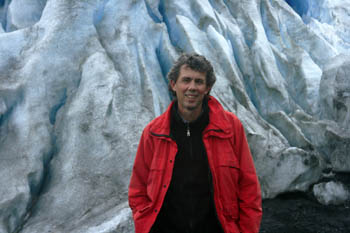
Photograph by George Johnson
About the Author
Gary Freeburg was born 1948 in Minneapolis, Minnesota, and was raised there. After serving in Vietnam in the U.S. Navy, Freeburg received three degrees in photography: his B.F.A. and M.A. from Minnesota State University at Mankato in 1974 and 1977 and his M.F.A. from the University of Iowa in 1978. He lived and worked in Alaska for twenty-five years and served as a professor of art at the University of Alaska’s Kenai Peninsula College, where he directed the art program and served as the curator in the campus art gallery that now bears his name. He is currently a professor of art and the director of Sawhill Gallery at James Madison University. Freeburg has worked with renowned photographers and educators, such as Ansel Adams, Oliver Gagliani, and John Schultz, and his photographs have been exhibited nationally and appeared in Under Northern Lights, Writers and Artists View the Alaskan Landscape and Looking North (University of Washington Press, 1998; 2000). He has received an Individual Artist Fellowship Grant from the Alaska State Council on the Arts, Anchorage; an honorary degree for his contribution to the visual arts from Alaska Pacific University, Anchorage; and an Art Educator of the Year Award in Higher Education from the Alaska Art Education Association. He was recognized by the Getty Center for Education in the Arts for his art advocacy work in Alaska and Washington, DC, and a documentary film by George C. Johnson, An Artist’s Journey to the Valley of Ten Thousand Smokes: The Photography of Gary Freeburg, serves as a capstone to Freeburg’s photographic work in the wilderness of Alaska. His Website is garyfreeburgartist.com
About the Essayists
John Eichelberger was born in Syracuse, New York, and received his B.S. and M.S. in Earth sciences from the Massachusetts Institute of Technology and a Ph.D. in geology from Stanford University in 1974. He spent the next seventeen years in New Mexico in volcano research related to development of geothermal energy, first at Los Alamos National Laboratory and later at Sandia National Laboratories in Albuquerque, where he was named Distinguished Member of Technical Staff and subsequently Supervisor of Geochemistry Division. While at Sandia, he became intrigued with subsurface exploration of volcanic systems through research drilling. In 1991, Eichelberger became a professor of volcanology at the University of Alaska in Fairbanks, where he aided in the growth of the Alaska Volcano Observatory, which now monitors the Katmai group of volcanoes, and began annual research and teaching pilgrimages to the Valley of 10,000 Smokes, introducing students from all over the world to the incomparable beauty and scientific mystery of the valley and of Katmai’s caldera. In 2007, Eichelberger left the university to lead the Volcano Hazards Program of the U.S. Geological Survey, but he continues to teach a volcanology class in Katmai National Park and Preserve every summer.
Jeanne M. Schaaf was born in Columbus, Nebraska, in 1953, and was raised in Beemer, Nebraska. She completed her B.A., M.A., and Ph.D. in anthropology with a specialization in archeology at the University of Minnesota in Minneapolis. In 1984, she joined the National Park Service Alaska Regional Office, where she was architect and manager of the Cultural Resource and Paleoecological Research for the Shared Beringian Heritage Program and the National Archaeological Survey Initiative Gulf of Alaska Coastal Survey from 1991–1995. Since 1996 she has been Cultural Resource Manager for Lake Clark and Katmai National Parks and Preserves, Aniakchak National Monument and Preserve, and Alagnak Wild River that comprise nearly 9,000,000 remote but culturally rich acres in southwestern Alaska, a program she built from the ground up. At the National Park Service she has conducted and managed research in the fields of paleoethnobotany, archaeology, history, ethnography, and museum collections. Schaaf has twice received the National Park Service Appleman-Judd-Lewis award for excellence in cultural resource management as well as the Esther Billman Award of Excellence from the Alaska Historical Society for the “impressive number of studies” produced under her direction that have greatly advanced understanding of human occupation and activities in southwestern Alaska.
Slide Show


My Place
My wide-brimmed hat sits on the top shelf of a closet just inside the front door of my home in downtown Harrisonburg, Virginia. I use it on occasion during the winter, but it comes out in early spring and travels with me between Chesapeake Bay and Alaska during much of the summer and into late fall.
Harrisonburg is where I work as Director of the Sawhill Gallery at James Madison University. My home is located in the Old Town neighborhood in the heart of this burgeoning city of 50,000 people. Being a university town and living but three blocks from campus, I experience the energy associated with a campus of 20,000 students and the constant activity of artistic and scientific presentations and performances. It is a nourishing environment and a wonderful and most convenient place to live.
Having lived previously for twenty-five years in Alaska, my emotional attachment to the land is greater there than it is here for the beautiful Shenandoah Valley. When I travel to Alaska from Virginia to make new photographs of Alaska’s wilderness, I find the first breath of cool Alaskan air exhilarating and refreshing.
The photographic work I do in Alaska is brought back to my studio in Harrisonburg. The studio is a place for reflection on the work I did in America’s great north. But a few hours to the east is Chesapeake Bay, where I keep a sailboat. It also serves as a second out-of-the-way home for me, because the sailboat takes me to the most accessible of wilderness areas back east―the ocean―for long periods of solitude and directionless thinking.


Copyright © 2013 Gary Freeburg. All rights reserved.