

$50.00 U.S. (trade discount)
E-book forthcoming.
164 pages with 84 color photographs by the author, 5 historic black-and-white photographs, 2 author photos, 2 news clippings, and 1 color drawing = 94 illustrations
12.0″ x 10.0″ landscape/horizontal
ISBN: 978–1–938086–86–1
Published in October 2021/Second printing March 2023
Distributed by Casemate/IPM
www.casemateipm.com
Published in association with the George F., Stephanie M., and George L. Traub Fund of the Jewish Foundation of Cleveland, Milton and Tamar Maltz Foundation, and Center for the Study of Place.
Events and Exhibitions
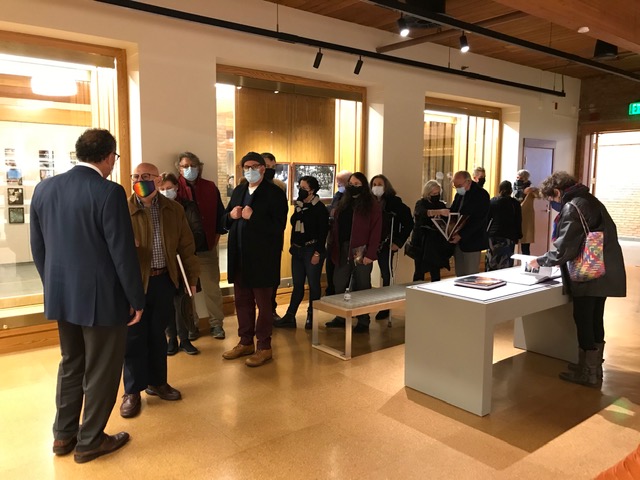
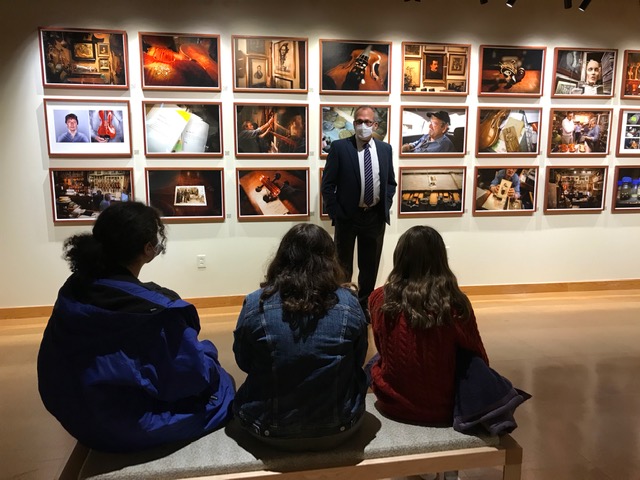
For the most current list of talks, exhibits, and book events, please visit Daniel’s website.
October 4, 2021
Artist Talk
Holocaust Memorial & Tolerance Center of Nassau County, NY
Violins of Hope bringing message of love to Pittsburgh Sandy Rosen, chair, and Pat Siger, co-chair of Violins of Hope Pittsburgh, talk with hosts David Highfield and Heather Abraham about the important message of love and tolerance these instruments are bringing to the city. (Watch on CBS News Pittsburgh)
2025 NPR interviews Daniel Levin
Listen to other interviews with Daniel Levin
Article”Violins and Hope Aims to Connect Catholic, Jewish Communities” Today’s Catholic 2025
by Daniel Levin
Foreword by Franz Welser-Möst and an interview with Assi Bielski Weinstein
Finalist for a 2021 Foreword Reviews INDIES Photography Book of the Year Award.
Amnon Weinstein, a renowned Israeli luthier (violin maker) who was trained by three of the most revered Italian luthiers of the twentieth century, had a vision many years ago to restore violins that survived the concentration camps and ghettos of World War II, even when their owners often did not. His “Violins of Hope” project may be one of the most creative, effective, moving, and magnificent approaches to understanding the Holocaust and how one heals from such pain and loss. For his efforts, Amnon and his Violins of Hope project received the 2020 Anne Frank Special Recognition Award, created by the Embassy of the Kingdom of the Netherlands to honor those who have demonstrated a commitment to fighting intolerance, antisemitism, racism, or discrimination.
Daniel Levin is the first photographer to depict Amnon’s workshop in Tel Aviv, his one-of-a-kind collection of violins that survived the Holocaust, and his artful process for restoring them. Through hauntingly beautiful photographs and compelling text, Violins and Hope becomes both an artful rendering of a very special man and a revelation of the ethereal, as we see how Amnon fulfills his dream of transforming tragedy into triumph in the most incisive and powerful way imaginable: bringing violins of the Holocaust back to life. Under Levin’s care, the ambiance and idiosyncrasies of Amnon’s workshop come alive, and the photographer’s uncanny ability to celebrate both place and process through the beauty of light is nothing short of remarkable.
Amnon has already restored eighty-six violins to their highest playable condition, and they have been used in acclaimed performances by symphonies to packed concert halls throughout the world, beginning in Istanbul in 2001. Purposefully, Amnon makes certain that young violinists as well as the world’s most famous virtuosos perform on his restored violins. In doing so, it’s as if the past owners of the violins come back to life and fill our minds and bodies and hearts with joy and remembrance.
The book’s foreword is written by Austrian-born Franz Welser-Möst, Music Director of the Cleveland Orchestra since 2002 and one of the most acclaimed conductors of the twenty-first century. The book concludes with the author’s interview with Assi Bielski Weinstein, Amnon’s wife and the daughter of Asael Bielski, the famous partisan fighter who, along with his brothers, saved 1,247 Jews in Belarus during World War II. Assi talks about the history of violins in Jewish life and during the Holocaust, the Bielski partisans, and the enduring legacy of the “Violins of Hope” project.
“Like a rich tapestry that keeps unfolding to reveal unexpected layers and designs, Levin’s book intertwines the stories behind the violins he photographed at Weinstein’s studio with important historical figures and events.”
—Eve Glover, Jerusalem Post Magazine (read full article here pdf)
About

About the Author
Daniel Levin is a contemporary artist and documentary photographer whose works primarily address sociological issues, and is a tenured Associate Professor of Photography at Cuyahoga Community College in Cleveland, Ohio. Levin’s works include Amnon Weinstein: The Luthier who Returned the Violins of the Holocaust to the Living, Perspectives Examined via the site-specific Camera Obscura, Organizational Successes and Failures of Post-Katrina Mississippi, Fatherhood, Walls as Metaphor for Divided Philosophies, and an art film exploring the birth of the creative thought entitled The Root: From Dishes to Synapses. His film To The Contrary, which celebrates the beauties of the mundane in a tumultuous world through high-speed HD cinematography, premiered in 2020 at Spaces Gallery in Cleveland, Ohio. Levin has been commissioned to make portraits of many well-known figures around the globe, including First Lady Barbara Bush and President George H. W. Bush, architect I. M. Pei and actor Martin Sheen, British Prime Minister Margaret Thatcher and Canadian Prime Minister Brian Mulroney, violinists Joshua Bell and Gil Shaham and musician Idan Raichel, magazine magnate Jann Wenner and Governor Mario Cuomo, iconic civil rights photographer Matt Herron and U.S. Senator and astronaut John Glenn. He resides in Cleveland Heights, and his Website is levinphoto.com.
About the Contributor
Franz Welser-Möst, a violinist from Austria who studied under the composer Balduin Sulzer, is among today’s most distinguished conductors. Since 2002, he has been Music Director and Principal Conductor of the Cleveland Orchestra, which The New York Times has declared “the Cleveland,” under Welser-Möst’s direction, to be the “best American orchestra” for its virtuosity, elegance of sound, variety of color, and chamber-like musical cohesion. As a guest conductor, Welser-Möst regularly conducts the Vienna Philharmonic and has served as General Music Director of the Vienna State Opera (2010 to 2014) and the Zurich Opera (2005–2008). In 2019, Mr. Welser-Möst was awarded the Gold Medal in the Arts by the Kennedy Center International Committee on the Arts in recognition of his long-lasting impact on the international arts community.
Slide Show


Praise
“Violins and Hope is a beautifully produced book. Large and heavy, with fine binding, thick paper and many gorgeous photographs, it may be called a coffee-table book in the best sense: one that anyone would be proud to display. Most of the story is told in the first quarter of the book, the rest being devoted principally to displaying and briefly commenting on the photographs. This makes more sense when we learn that author Daniel Levin is a professional photographer.”
—Raphael Klayman, The Strad (read full review here)
“Like a rich tapestry that keeps unfolding to reveal unexpected layers and designs, Levin’s book intertwines the stories behind the violins he photographed at Weinstein’s studio with important historical figures and events.”
—Eve Glover, Jerusalem Post Magazine (read full article here pdf)
“Extraordinarily Moving”
—Tom Service, BBC London, Music Matters
“The violin has for centuries been an important symbol of Jewish culture. Bronislaw Huberman, who owned the Stradivarius upon which I play, used his violin to change the world. Through his influence as a beloved artist and his undying determination, Huberman helped countless European Jewish musicians and their families escape the inevitable fate of the Holocaust by creating a new orchestra in the Jewish motherland. The restored “violins of hope” are connected to the same story and serve as a reminder of human resilience and the truly immense power of music, which can uplift the soul during even the most dire of circumstances. Daniel Levin, in his magnificent book, Violins and Hope, brings the story full circle by showing the world how Amon Weinstein restores violins that survived such a dark past so they can sing forever.”
—Joshua Bell, violinist and conductor
“The noble and righteous quest of restoring to life and to the concert-hall Jewish violins that survived the Holocaust, although many of their owners perished, is movingly narrated by the insightful commentaries and richly toned, intricately layered photographs of Daniel Levin. Levin’s Violins and Hope takes us into the Tel Aviv workshop of the story’s protagonist, renowned Israeli luthier Amnon Weinstein, and conveys not just his tools and methods, but the heart and soul of this extraordinary man and his vision.”
—Barbara Tannenbaum, Curator of Photography, Cleveland Museum of Art
“Like Amnon’s restored violins, Daniel’s book is a lasting gift to us all.”
—Franz Welser-Möst, Conductor & Music Director, The Cleveland Orchestra, Author of Als ich die Stille fand. Ein Plädoyer gegen den Lärm der Welt
“Any violin ever made is the embodiment of birth and hope.
From the shape of its body to the strength of its bow,
the images are rendered with love. To see them is to be informed
by time. The time Daniel Levin took to make the pictures and the time
Amnon Weinstein takes to restore the violin.
Each step is speaking of patience, crescendo, and singular symphonic tone.
Tone is the rapture that embraces us collectively and alone.”
—Larry Fink, photographer and author of Boxing, The Forbidden Pictures, Night at the Met, Primal Elegance, and Social Graces
“Violins and Hope is a fascinating and moving documentation of how sounds of memory not only connect people and their stories across time and space, but also possess the power to convey the message of hope as an aspect of Holocaust remembrance.”
— Maoz Azaryahu, Director of the Herzl Institute for Zionism, University of Haifa
“Daniel Levin’s careful and compassionate visual documentation of these wonderful artifacts and their preservationist provides a window into both the perseverance of humanity and a reminder of the horrors of the Holocaust.”
—Dr. Kenneth J. Bindas, Professor of History at Kent State University and author of Modernity and the Great Depression: The Transformation of American Society, 1930–1941
“This lavishly photographed book details the process used by master luthier Amnon Weinstein in his Violins of Hope project, repairing and resurrecting violins which were damaged, lost, confiscated, or otherwise ruined in the Holocaust and the ghettos. The photographer, Daniel Levin, shows the many steps Amnon takes to identify and catalog each violin and how he diagnoses which repairs are needed on any given violin.”
—Eli Lieberman, Assistant Librarian, Association of Jewish Libraries News and Reviews (read full blurb here)
My Place
A few years ago I had the opportunity to have a sabbatical. I traveled to Prague for ten days, followed by another ten days to visit my ex-pat graphic designer cousin in Basel, Switzerland. Gary’s long-time friend and mentor was Tom Bluhm (b. 1943). Tom had been IBM’s Program Manager of Graphic Design Operations during its heyday. During those years at IBM he directed legendary freelance designer Paul Rand, and on a few occasions Charles and Ray Eames attended their design meetings. Today Tom lives in a home he designed above the village of Vernamiège, high up in the Swiss Alps. His painting studio has a view one cannot imagine. The poured concrete and glass jewel box of a place is a modern take on an old Swiss mountain chalet. Vernamiège is in the French-speaking region of Switzerland. The village has a grand total of twenty-five households within its boundaryless mountainside.

Tom is a serious cyclist. One must be, if you are going to ride when your front yard is considered some of the best altitude bike racing terrain in the Alps. When he’s not biking, he’s painting beautiful works.
Gary and I visited Tom for a few magical days. When I awoke the morning after our arrival, while the others were still asleep, I put on my jeans, leaving my shoes behind, and walked out one of the second-floor glass doors on to a frighteningly pitched grassy Swiss mountain hillside. Below me was the village, below that a fantastical valley, across the valley was another majestic swiss mountain. Above me was the rest of Vernamiège’s mountain, with the addition of two long-coated wild horses. There were no fences. I ascended to visit the horses, careful not to slip, as the grasses were wet with morning dew. I spent maybe twenty minutes up there with my new friends. The sun had just risen over the back-side of the mountain, as light snow fell seemingly slower than gravity should allow for. This was suddenly my place.Four years out of college, while I was living in Chicago as a freelance photo assistant, Jeff, my lifelong friend, asked me if I would like to join him on his submarine for a number of days. He informed me that I could neither let anyone know the actual reason why I was leaving Chicago nor where I was traveling to meet the sub or even when I would return. Jeff and I go back through our teen years. We shared most of our experiences together, many of which included sneaking up to Cleveland in one of our parent’s cars to visit our friends.
I met the USN-757 Alexandria fast-attack nuclear submarine in Jacksonville, Florida, the night before our departure. While it was longer than a football field, I learned that ballistic submarines would dwarf it. I will never forget the smell of the air on the boat (as sailors call it). It wasn’t unpleasant, but it was unusual and distinct. Modern submarines make their own air by taking in sea water, desalinating it to the point that it becomes distilled, then splitting off the hydrogen from the oxygen. The hydrogen is carefully released into the sea. The pure oxygen is then bled into the submarine’s existing air. When the air is filtered through a charcoal bed, the recipe for unique submarine air is complete.
We went to sea the following morning. On the second morning, an officer awoke me from my bunk, informing me that Lieutenant Commander Coran (Jeff) was the current Officer of the Deck and that he asked to have me suited up with safety gear and brought to the bridge at the top of the conning tower to join him. On a submarine at sea, when there is an Officer of the Deck it means the 100+ submariners are under the sea’s surface, while the Officer of the Deck and one enlisted sailor are on top of the conning tower navigating the sub. Needless to say, at this moment in our journey, we were no longer at depth, although we would be once again a few hours from then. After three days, after an occasionally adventurous roller-coaster of a ride, I was dropped off in Groton Connecticut. I flew home from there.
Why, you may ask, would a yoga-practicing, empathy-sensitive man of the arts consider writing about such an experience as being positively significant enough to mention it in an essay about “my place”? Perhaps this explains why. Just as the sun would crack the horizon years later in Vernamiège when I encountered the horses, the sun was beginning to show up somewhere in the landless Atlantic, directly above of the sub’s bow that seemed to be splitting the sea in two. As normal air returned to my lungs, Jeff and I took it all in. Aside for the charts in front of us, and the enlisted man, binoculars in front of their eyes, continually rotating scouring the horizon, it was just us and an incredibly magnificent expanse of a maritime world. I was proud of my friend’s contribution to the nation’s security.
We may have spent an hour up there; I have no idea really. Time is funny on a submarine. There are no windows. There isn’t even a windshield for the “driver.” But what I do know is that, in that beautiful place, with my brother-like dear friend, it seemed that Jeff and I were once again sneaking off for an adventure far from our unknowing parents, and, once again, he had the keys. This was my kind of place.
For the last thirty years, I have hosted my extended family for Thanksgiving. Due to a divorce years ago, followed years later by the empty-nest syndrome, I now live in a small Craftsman bungalow. Exactly a century ago, its pieces were shipped to Cleveland via train and brought on site via truck, then assembled by local workers. While on the small side, it is filled with amazing warm wood and lovely Arts & Crafts craftsmanship. As I write this, it is the time of COVID-19. As a result, like most Americans, our Thanksgiving Day in 2020 was unrecognizably paired down. To my surprise, I expect that day will forever be a highlight of my life. Following the turkey being removed from the oven, my three adult daughters arrived with side dishes in hand and masks on faces. It was a simple yet magnificent day. We are all here: Allie, Claire, Joey, and our dog, Boulder, sharing a home-cooked meal and our company with one another. With a fire burning all day long in the den, we were together, healthy and all deeply appreciative. Somehow, by our being together within the confines of our cabin-like home, we seemed to have found the antidote to the dangers that lay beyond its walls. Of all places, this is now my place.
I know I am an introvert, but I don’t need Myers or Briggs to tell me that life is not as simple as that. There is a commonality to these my places, no matter the beautiful, mundane, or exotic experiences I had. And to be a full experience, I must share it with those close to me. A place’s pinnacle, and the experiences that come along with it, never truly reach me without it being a shared experience.
One of the great places of the world must be the workshop of Amnon Weinstein, the famous luthier in Tel Aviv. Violins and Hope: From the Holocaust to Symphony Hall is my way to share my experiences in that special place, making the My Place journey complete.
Copyright © 2020 Daniel Levin. All rights reserved.